Enterprise Content Management Software vs. DMS: What Real Estate Firms Actually Need
When real estate firms need full ECM, when a DMS is enough, and four conditions that justify the added capture, workflow and integration complexity.
Published September 7, 2026 · By ARC-Files · 25 min read
Published: September 7, 2026 | By ARC-Files
Enterprise content management software goes beyond a basic document management system by connecting content to capture, classification, enterprise workflows, multiple repositories, records governance, case processes, and other business applications. For real estate firms, full ECM is justified when document management becomes a cross-system process problem rather than primarily a search, metadata, retention, or repository-governance problem.
The mistake is treating ECM as the premium version of a DMS. It is not. A real estate company with inconsistent SharePoint libraries needs a very different architecture from a company processing thousands of incoming documents through formal workflows across acquired repositories, regulated cases, and multiple systems of record.
Key Takeaways
- ECM and DMS overlap, but ECM addresses a broader combination of content, systems, processes, and enterprise integration.
- Four conditions genuinely strengthen the case for full ECM: high-volume intelligent capture, multi-repository federation, formal case management, and content-driven process automation.
- If none of those four conditions applies, full ECM can introduce implementation and operating complexity without solving a proportionately larger problem.
- Microsoft 365 can cover substantial document-management, retention, OCR, workflow, search, and external-content requirements, but those capabilities still need architecture and governance.
- If two or more of the four ECM conditions are central to the business, a full content-services platform deserves serious consideration.
ECM and DMS Are Not Tiers of the Same Thing
A document management system asks:
How do we control documents?
An enterprise content management architecture asks:
How does content participate in the organization's systems and processes across its entire lifecycle?
AIIM defines enterprise content management as the combination of strategies, methods, and tools used to capture, manage, store, preserve, and deliver information supporting organizational processes throughout its lifecycle.
That scope is wider than storing lease files correctly.
ECM can involve:
- document management;
- intelligent capture;
- OCR;
- automated classification;
- records management;
- workflow;
- business process management;
- case management;
- enterprise search;
- repository federation;
- integrations with ERP, CRM, HR, accounting, and other systems;
- archiving;
- information governance.
The terminology has also evolved. Gartner moved away from treating Enterprise Content Management as the name of one monolithic software market and toward the concept of content services. AIIM describes content services as a more modular, multi-repository approach to delivering outcomes historically associated with ECM.
Modern ECM does not necessarily mean replace everything → put every document in one enormous repository. A modern content-services architecture can instead connect several systems while applying common capture, workflow, search, metadata, governance, and process capabilities.
The right question is not "Do we want DMS or the better ECM version?" It is: How complex is the content problem we are actually trying to solve?
Related: What Is a Document Management System? A Real Estate Buyer's Framework.
The Four Conditions That Justify Full ECM
The Complexity-to-Value Curve is a practical way to decide whether full enterprise content management software is proportionate to the problem.
The Complexity-to-Value Curve
This is a buyer's framework, not an industry standard. Its purpose is to prevent both under-buying and over-buying.
| ECM conditions present | Architectural signal | Likely direction |
|---|---|---|
| 0 of 4 | Primarily search, metadata, retention, permissions, or SharePoint governance | DMS or governed existing platform |
| 1 of 4 | One specialized enterprise requirement | Extend current platform or evaluate targeted content service |
| 2 of 4 | Content is becoming a process/integration problem | Full ECM/content-services evaluation justified |
| 3 of 4 | Multiple enterprise content problems interact | Strong ECM case |
| 4 of 4 | Content is operational infrastructure across systems and processes | Full ECM/content-services architecture likely appropriate |
Condition 1: High-Volume Inbound Capture Requiring OCR and Classification at Scale
Consider an organization receiving documents through scanned mail, shared inboxes, vendor portals, acquisition data rooms, tenant submissions, invoices, tax documents, contracts, inspection reports, insurance records, and application forms.
A simple DMS can accept those files. The harder problem is automatically determining what document arrived, which property or entity it belongs to, what data should be extracted, which workflow should begin, who should review exceptions, and where the final record should be governed. This is the domain of intelligent document processing, or IDP.
OpenText describes capture and IDP as combining information capture, AI and machine learning, extraction, classification, and downstream process automation. Laserfiche similarly combines intelligent data capture with document management and process automation in its broader platform. Microsoft 365 is not incapable of this: Microsoft's document-processing services can classify unstructured documents and extract fields from contracts, letters, forms, and other content.
The distinction is scale and centrality. If OCR and classification are occasional conveniences, buying a full ECM stack for them is difficult to justify. If high-volume capture is the front door to a major business process, ECM becomes more defensible.
Condition 2: Multiple Repositories Must Behave Like One Information Estate
Real estate portfolios accumulate repositories through acquisitions, regional autonomy, joint ventures, former operating companies, legal systems, property platforms, Box, SharePoint, network drives, and legacy ECM systems.
The naive response is: Move everything into one system. That may create an enormous migration project without eliminating the reasons those repositories exist.
Modern content-services platforms can instead connect external content. M-Files publicly documents external repository connectors that expose content from other repositories inside its interface. External content can remain in the source system while users search or view it through M-Files, and selected items can be promoted into managed objects with metadata and workflow capabilities.
Microsoft also supports more than 100 prebuilt Microsoft 365 Copilot connectors for bringing external sources such as Salesforce, ServiceNow, Confluence, Jira, GitHub, and Google Drive into Microsoft Graph-powered search experiences.
Search federation asks Can we find it? Governance asks Can we control it? Process federation asks Can the content participate in a workflow without moving?
Condition 3: Regulated Case Management with Formal Adjudication
A document workflow usually has a predictable path: Submit → Review → Approve. A case is different. It can remain open for months, collect documents gradually, branch depending on evidence, change owners, contain tasks with different deadlines, be escalated or reopened, involve external parties, and require a complete decision history.
Potential real estate examples include complex tax appeals, insurance claims, formal compliance investigations, dispute files, certain legal matters, regulatory submissions, and structured tenant or resident cases in regulated housing environments.
OpenText uses business workspaces to organize content, people, data, and tasks around a project, case, or business goal. OpenText also combines workflow with case-management capabilities. A SharePoint site can hold a case file, and SharePoint lists plus Power Automate can be engineered into a case process. The relevant question is whether your organization wants to build and maintain that application behavior itself.
Condition 4: Content Drives Processes with Deadlines and Escalation
The fourth condition appears when content does not merely sit inside a workflow. The content drives the workflow.
Invoice arrives → classify vendor/property → extract amount
→ match purchase order → route exception → request approval
→ escalate if overdue → write status back to financial system
→ preserve final evidence
Or:
Certificate of insurance arrives → identify property/vendor
→ extract expiration date → compare requirement → route deficiency
→ follow up → escalate → close compliance item → retain evidence
This is different from emailing someone a document for approval. Laserfiche documents workflows that route documents, update metadata, interact with external systems, send notifications, set deadlines, and monitor process performance. OpenText likewise combines content with workflow automation, intelligent capture, business integrations, governance, and archiving.
What ECM Platforms Do That a Basic DMS Does Not
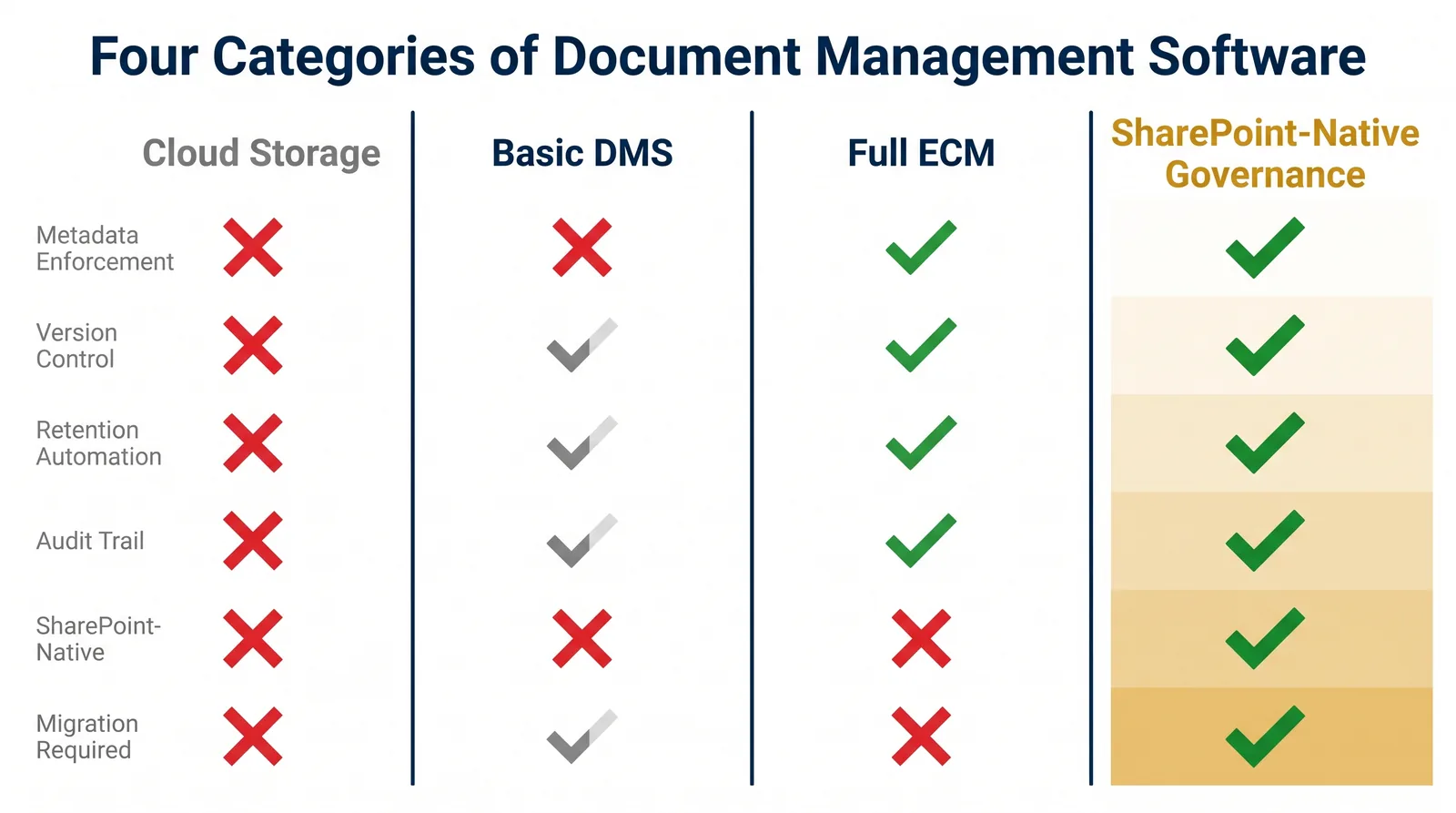
A basic DMS and full ECM platform can both provide document storage, metadata, versioning, permissions, search, audit history, and retention. That overlap is why buyers get confused.
The difference becomes clearer when comparing the operating envelope.
| Capability | Basic DMS | Full ECM / content services |
|---|---|---|
| Controlled document repository | Core | Core |
| Metadata and taxonomy | Core | Core |
| Version control | Core | Core |
| Records governance | Often available | Usually broader/deeper |
| OCR | Available in many systems | Often integrated into capture architecture |
| Automated classification | Varies | Common enterprise capability |
| High-volume inbound capture | Limited to moderate | Strong use case |
| Multi-repository federation | Usually limited | Major use case |
| Enterprise application integration | Connectors/APIs | Typically central to architecture |
| Formal case management | Usually outside core DMS | Often available |
| Cross-system process orchestration | Limited/adjacent | Strong use case |
| Process monitoring | Basic workflow status | Broader workflow/process analytics |
| Repository-independent content services | Limited | Core content-services concept |
The distinction is therefore not DMS = small company, ECM = large company. A large property owner with a relatively simple Microsoft 365 document estate may need only strong DMS governance. A smaller regulated organization processing document-heavy cases across several systems may legitimately need ECM. Complexity matters more than headcount.
What You Pay for It: ECM Cost Line Items Nobody Quotes Up Front
The biggest mistake in ECM budgeting is treating the software license as total cost. This section deliberately avoids dollar estimates because enterprise pricing and implementation scope vary widely. Instead, require every proposal to identify these cost categories.
1. Core platform licensing
Named users, concurrent users where applicable, external users, storage, environments, and production and test instances.
2. Capture and IDP
Whether OCR, classification, extraction, AI processing, or document transactions are included or separately metered. Microsoft document-processing services, for example, require a linked Azure subscription and use pay-as-you-go transaction billing.
3. Repository connectors
If the business case depends on connecting SharePoint, Box, network drives, ERP, CRM, or legacy ECM, price those connections explicitly. M-Files documentation notes that external repository connectors may require an additional license, depending on the connector.
4. Integration development
Separate prebuilt integration from custom integration. Identify API development, middleware, authentication design, data mapping, testing, and ongoing maintenance.
5. Migration and repository analysis
Inventory, deduplication, metadata mapping, permission mapping, format remediation, validation, reconciliation, and rollback planning. Federation replaces some migration effort but introduces connector and governance work.
6. Taxonomy and classification design
Define document classes, metadata, business relationships, retention classes, ownership, and exception handling. Bad taxonomy at enterprise scale produces enterprise-scale inconsistency.
7. Workflow and case modeling
Every custom process must be designed, configured, tested, documented, monitored, and changed when the business changes.
8. Process capacity and transaction limits
Ask what happens to cost and performance at 10 times current workflow volume. Power Automate and comparable platforms apply action, connector, throttling, concurrency, or capacity constraints.
9. Governance administration
Someone must own permissions, records rules, taxonomy, workflow versions, integration credentials, exception queues, audit configuration, connector health, and upgrades.
10. Change management and training
Employees may continue using email attachments, work outside controlled processes, reject classification rules, duplicate data, or create local shadow repositories. ECM changes business process and requires adoption work.
The Microsoft 365-Native Alternative and Its Honest Ceiling
Microsoft 365 can cover much more of the ECM problem than a basic SharePoint comparison suggests. A modern Microsoft architecture can combine:
- SharePoint Online for document libraries, metadata, content types, search, access, and collaboration.
- Microsoft Purview for retention and records management.
- Document processing and OCR for classification, extraction, and searchable scanned content.
- Power Automate for approvals and document/process workflows.
- Microsoft 365 Copilot connectors for indexing external content from non-Microsoft repositories.
- Power Apps and Dataverse for custom line-of-business applications where structured process data needs more than a document library.
That is a substantial platform. But it has an honest ceiling.
The more an architecture depends on custom Power Apps, complicated Dataverse structures, dozens of flows, external connectors, multiple AI processing models, cross-system exception handling, formal case state, and aggressive workflow SLAs, the more the organization is effectively building its own content-services application.
At that point, evaluating a platform where those capabilities are part of the core product becomes rational. The fact that Microsoft 365 can be engineered to do something is not proof that engineering it yourself is the least expensive or lowest-risk option.
Related: SharePoint document governance for commercial real estate.
Decision Table: Which Category Fits Your Conditions?
Use this as a first architecture screen.
| Your condition | Shared/cloud repository | Basic DMS | Governed Microsoft 365 | Full ECM/content services |
|---|---|---|---|---|
| Need better document search | Possible | Strong | Strong | Strong |
| Need enforced real estate metadata | Weak–Moderate | Strong | Strong | Strong |
| Need document retention and audit | Varies | Strong | Strong | Strong |
| Existing documents already in SharePoint | Poor reason to move | Possible | Best natural fit | Consider only with broader need |
| High-volume OCR/classification intake | Limited | Moderate | Moderate–Strong with processing services | Strong |
| Several repositories must stay in place | Weak | Varies | Moderate–Strong with connectors | Strong |
| Formal case management | Weak | Weak–Moderate | Possible with Power Platform build | Strong |
| Complex cross-system workflow with deadlines | Weak | Moderate | Possible with Power Platform | Strong |
| Minimal internal administration desired | Strong for simple use | Moderate | Moderate | Depends on implementation |
| Need specialized process application | Weak | Weak | Custom-build option | Strong |
The Decision Rule
Zero ECM conditions: Improve DMS or existing-platform governance first.
One ECM condition: Price a targeted service and a full ECM option. Do not assume either wins.
Two ECM conditions: Run a serious ECM/content-services evaluation.
Three or four ECM conditions: Treat full ECM as the default architecture to beat.
When ECM Is the Right Answer and a SharePoint Layer Is Not
This is where vendor content usually becomes evasive. It should not.
If your company has none of the four ECM conditions, full enterprise content management can become a cost and operating burden that your use case does not justify.
If your problem is inconsistent metadata, poor search, weak retention, permissions, and different configuration in each SharePoint market, you probably do not need a full enterprise content-management replacement. You need better governance.
But reverse the situation. Suppose the organization ingests large volumes requiring classification and extraction, must federate acquired repositories that cannot all be migrated, runs formal case processes with evidence and decisions, and drives cross-system workflows with escalation and process monitoring.
A SharePoint-native governance layer, including ARC-Files, is the wrong answer to that complete problem.
M-Files, Laserfiche, OpenText, Hyland, IBM FileNet, and other broader document/content platforms exist because those requirements are real. The product selection may still favor a Microsoft-centered architecture after evaluation, but it should win because its total architecture is better, not because the company already owns Microsoft 365.
Those broader capabilities are not unnecessary when the business actually needs them. They are the reason ECM exists.
Frequently Asked Questions
What is enterprise content management software?
Enterprise content management software supports the capture, management, storage, preservation, governance, processing, and delivery of organizational content across its lifecycle. Modern ECM or content-services architectures can also include intelligent capture, workflow automation, records management, case management, enterprise integrations, search, archiving, and connections to multiple repositories.
What is the difference between ECM and DMS?
A DMS primarily controls documents through metadata, search, permissions, versions, workflows, and lifecycle rules. ECM addresses the broader relationship between content and enterprise processes, including capture, classification, multiple repositories, system integrations, records management, process automation, and case-oriented work. A DMS can be one component of a broader ECM architecture.
Is SharePoint an ECM?
SharePoint can provide many ECM capabilities when combined with Microsoft Purview, document processing, Power Automate, Power Platform, and Microsoft 365 connectors. It is more accurate to evaluate the complete Microsoft architecture than SharePoint alone. For complex cases, federation, or process automation, organizations may need substantial configuration or custom application work rather than receiving a turnkey ECM process out of the box.
Do we need ECM or just better SharePoint governance?
If the main problems are inconsistent metadata, poor search, weak retention, permissions, or provisioning inside an existing Microsoft 365 estate, better SharePoint governance is usually the more proportionate first step. If two or more conditions involve high-volume capture, repository federation, formal case management, or cross-system process automation, evaluate full ECM seriously.
Where ARC-Files Fits
ARC-Files, the SharePoint-native document management platform from Al-Rafay Global, belongs on the lower-complexity side of the decision curve.
The appropriate use case is an organization whose documents already live primarily in Microsoft 365 and whose main problems are document search, metadata consistency, retention/compliance controls, taxonomy, and repeatable governance across properties or markets.
ARC-Files should not be positioned as a substitute for full ECM where the business requires high-volume intelligent capture, broad repository federation, formal enterprise case management, or sophisticated cross-system content-process orchestration.
For Microsoft 365-centric organizations, compare SharePoint and M-Files before deciding whether the requirement is better SharePoint governance or a broader platform category.
Sources Cited
- AIIM — Enterprise Content Management. Defines ECM around capture, management, storage, preservation, delivery, and organizational processes.
- AIIM — ECM vs. Content Services vs. Intelligent Information Management. Explains the move from traditional ECM terminology toward modular multi-repository content services.
- M-Files — platform and external repository documentation. Documents metadata-driven management, workflow, governance, and content residing in external repositories.
- Laserfiche — platform, process automation, and integration documentation. Documents intelligent capture, workflows, deadlines, integrations, governance, and ECM functionality.
- OpenText — Content Cloud and Content Management. Documents document management, IDP, workflows, case-oriented workspaces, records governance, archiving, and enterprise application integrations.
- Microsoft Learn — Microsoft 365 content and records services. Documents SharePoint/Purview retention, document processing, OCR, external connectors, Power Automate, and Dataverse capabilities and limits.
Last updated: September 7, 2026
Keep reading
Suggested Articles
Continue exploring document management, SharePoint governance, and compliance for commercial real estate teams.