Real Estate Document Management Software: The 2026 Enterprise Guide
An educational guide to the four document management software categories, six key governance features, and why most enterprise real estate teams need governance infrastructure rather than platform replacement.
Published August 15, 2026 · By ARC-Files · 16 min read
Published: August 15, 2026 | By ARC-Files
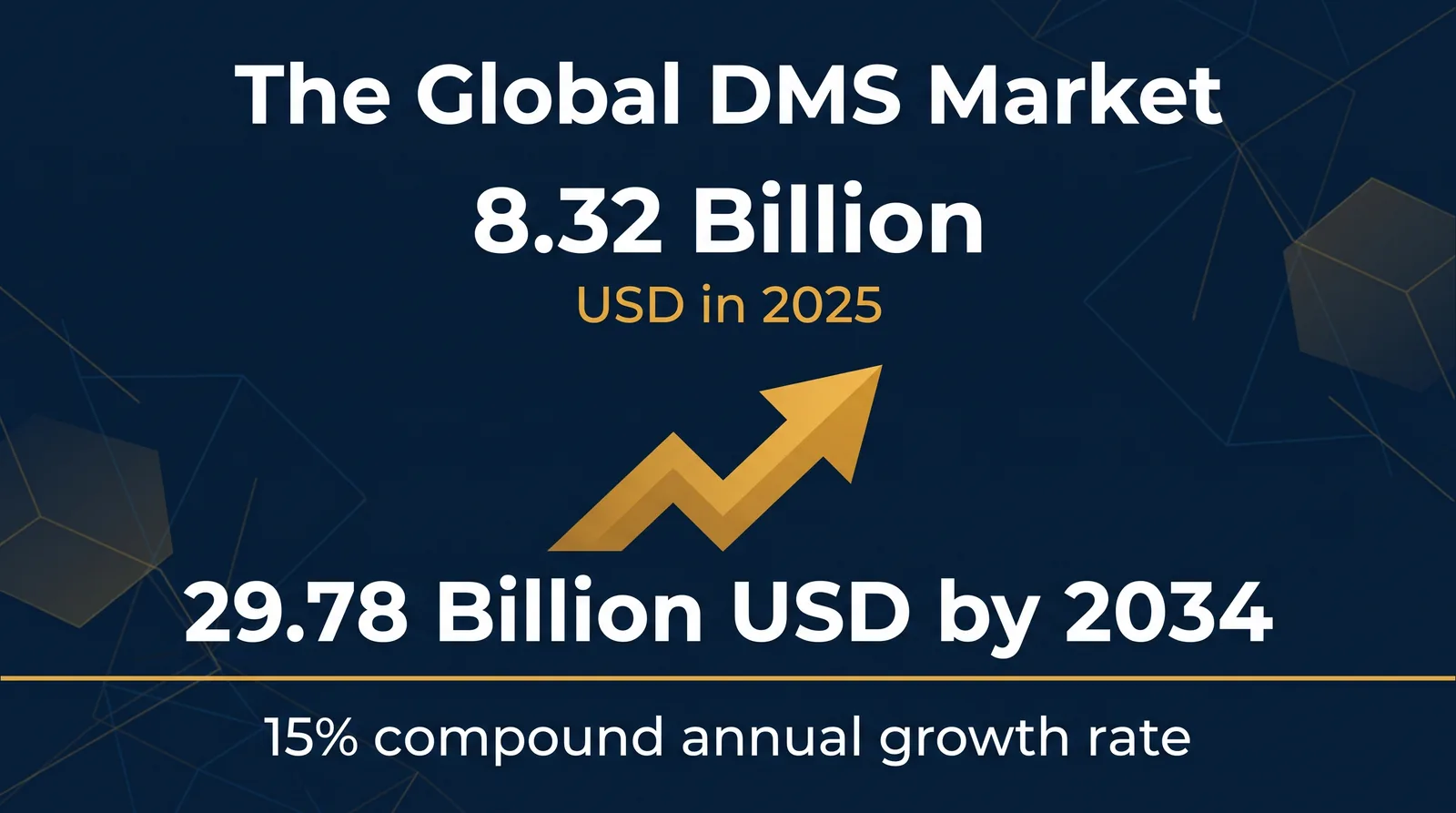
The global document management software market reached $8.32 billion in 2025. By 2034, it is expected to reach $29.78 billion. Enterprise real estate teams are driving much of that growth.
However, knowing that market growth exists is not the same as knowing what document management software actually is. Enterprise real estate leaders need to understand the distinct categories, the features that matter, and how governance infrastructure fits into decisions about infrastructure.
This guide is for CRE operations leaders, IT directors, and finance teams. You need to understand what document management software means at enterprise scale, what features separate governance from storage, and how to evaluate platforms before making changes to infrastructure your team depends on.
Key Takeaways
- Document management software falls into four distinct categories with very different architecture and governance depth.
- Six features separate genuine governance platforms from organized folder systems: enforced metadata, version control, retention automation, audit trails, permission controls, and portfolio-wide search.
- Most enterprise real estate firms already have the platform they need; the gap is governance infrastructure, not infrastructure itself.
- Understanding the feature framework and vendor claims is essential before evaluating any specific platform or technology decision.
What "Document Management Software" Actually Means for Real Estate
The term "document management software" describes everything from basic cloud storage to enterprise content platforms. That broad definition creates confusion when enterprises try to evaluate what they actually need.
For enterprise real estate, real document management software must do five things:
- Enforce metadata at upload as required fields, not optional ones.
- Track document versions with locked history from draft through signature.
- Automate retention policies by document type and lifecycle event.
- Produce audit trails that hold up to investor or regulatory review.
- Enable portfolio-wide search across all properties, markets, and document types.
If a system does not do all five, it is a storage system. Storage and governance are not the same problem, and solving one does not solve the other.
The Four Categories: A Comparison Table
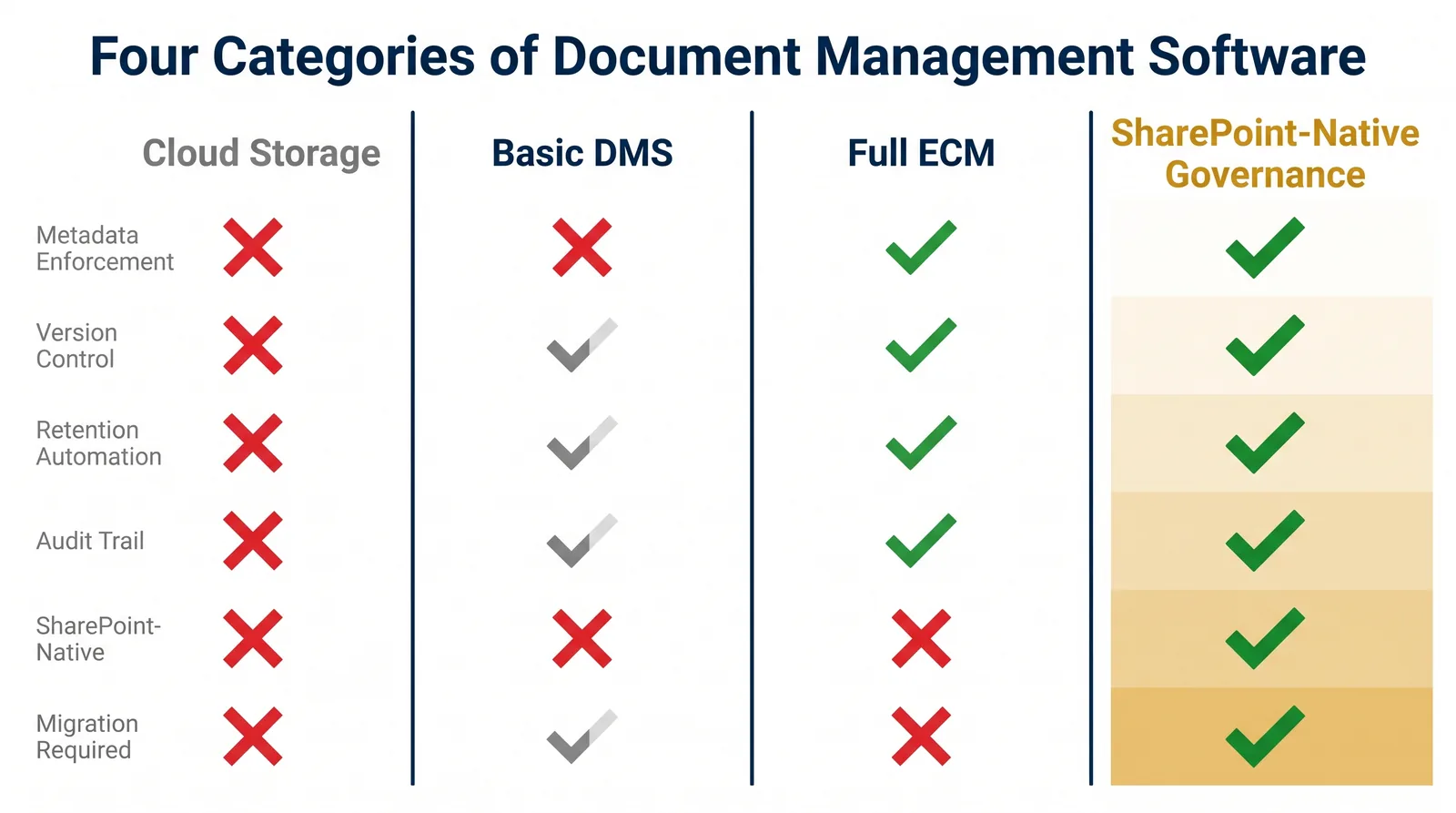
Real estate teams encounter four distinct categories during software reviews. Understanding the differences is the foundation for evaluating any specific platform.
| Category | Metadata | Retention | Audit Trail |
|---|---|---|---|
| Cloud Storage | None | None | Minimal |
| Basic DMS | Optional | Manual | Limited |
| Full ECM | Enforced | Automated | Full |
| SharePoint-Native | Enforced | Automated | Full |
The Six Features That Define Real Governance
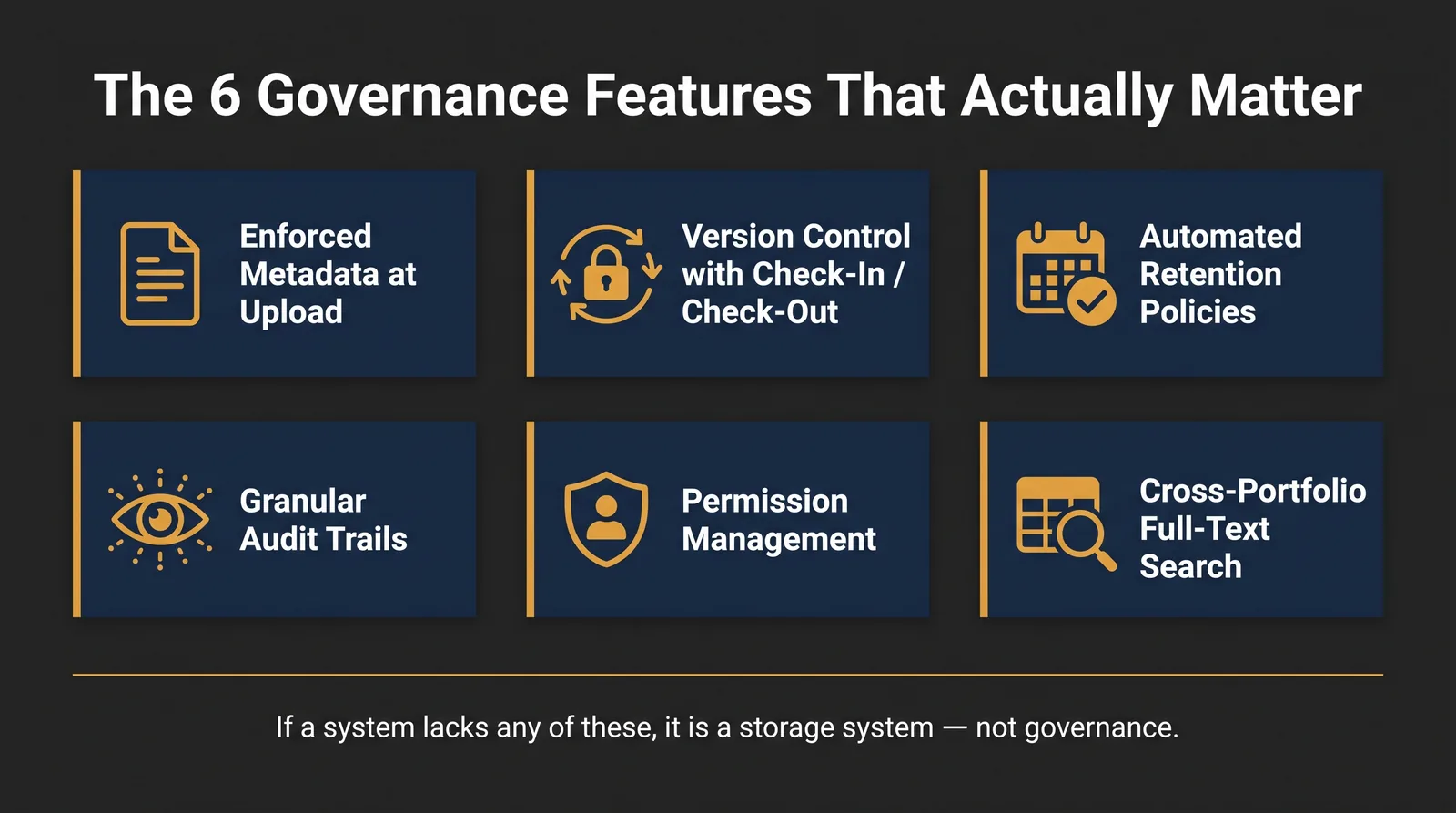
Six features consistently separate platforms that provide true governance from systems that provide storage with a better interface.
- Enforced metadata at upload: Users cannot save a document without completing required fields. Not optional. Not after upload. Required at the moment of filing.
- Version control with check-in/check-out: Only one person can edit at a time, preventing conflicting versions. Signed documents are locked. Distribution is controlled.
- Automated retention policies: Schedules run on their own based on classification. Documents are disposed of automatically when retention periods end.
- Granular audit trails: Complete records of who accessed documents, what changed, when sharing occurred, and when retention events happened.
- Permission management with sprawl controls: Permissions are structured by role. Access reviews are routine. External access is time-limited and removable.
- Full-text cross-portfolio search: Users can find any document from a single search interface without knowing which folder or site it lives in.
Why Microsoft 365 and SharePoint Are the Enterprise Baseline
By 2026, Microsoft 365 holds over 50% of the enterprise productivity suite market globally. For enterprise real estate firms managing 50+ properties, Microsoft 365 is the operating baseline — not because it is the best document management software, but because it is already deployed and embedded in daily workflows.
This distinction matters for how organizations solve governance gaps. The question is not whether to replace your infrastructure. The question is whether to add governance enforcement on top of the infrastructure you already own.
SharePoint is a strong enterprise content repository. It scales well, integrates with Microsoft tools your teams already use, and has solid security. The gap is not the platform. The gap is governance enforcement — metadata requirements, retention automation, and audit controls that default SharePoint does not include.
What a Governance Layer Adds on Top of SharePoint
A SharePoint-native governance layer does not replace SharePoint. Instead, it adds the enforcement and automation that default SharePoint does not provide.
- Metadata Enforcement: Required fields at upload for property ID, document type, market, counterparty, effective date, and retention class.
- Provisioning Automation: New property sites are built automatically with the correct structure, metadata schema, permission groups, and retention policies.
- Retention Automation: Retention schedules run automatically based on classification. Disposal workflows trigger when retention periods end. Legal holds can be applied portfolio-wide.
- Audit Trail Organization: SharePoint audit logs are pulled, organized into structured reports, and made exportable on demand for regulators or investors.
- Cross-Portfolio Search: Enforced metadata becomes the search index, enabling users to find documents by property, market, or type across the entire portfolio in seconds.
Why Most Real Estate Teams Don't Need Full ECM
Full ECM platforms (OpenText, M-Files Enterprise, Laserfiche Enterprise) are capable systems built for organizations with complex cross-system workflows and diverse content types.
Most enterprise real estate firms have a simpler document profile: structured document types with defined retention schedules, portfolio-level consistency needs, audit trail requirements, and deep integration with Microsoft 365.
Full ECM can deliver all of that. However, it requires platform migration, metadata schema rebuilding, user retraining, and ongoing dual-system maintenance. A SharePoint-native governance layer delivers 80-90% of what enterprise ECM delivers for real estate at a fraction of the implementation complexity and cost.
The architectural question—replace infrastructure or govern it—is where most successful evaluations start. For firms already on Microsoft 365, the answer is usually governance.
Understanding the Platform Evaluation Framework
Before evaluating any specific platform, real estate teams should understand what to look for when reviewing document management software. These questions establish what any platform must deliver.
- Is metadata enforcement mandatory at upload, or optional?
- Does version control include check-in/check-out, or only history?
- Are retention policies automated at classification or manual per document?
- How is the audit trail organized for export and regulatory review?
- Does the system support portfolio-wide full-text search from one interface?
- Does setup require moving documents out of SharePoint, or work inside it?
- Are new property sites set up automatically or by hand?
- How are permissions structured, and what stops permission sprawl?
- What does retention disposal look like, and how are legal holds applied?
- What is the implementation timeline, and is it measured in weeks or quarters?
Frequently Asked Questions
What is document management software?
Document management software is a system for storing, organizing, tracking, and governing digital documents across their full lifecycle. For enterprise real estate, this means enforced metadata, automated retention, version control, audit trails, and portfolio-wide search.
What is the difference between DMS and ECM?
A DMS focuses on storing and governing structured documents. An ECM manages all content types including emails, video, and rich media with cross-system workflows. Most real estate teams need DMS-level governance, not full ECM.
Does SharePoint count as document management software?
SharePoint is a strong content repository. Default SharePoint is not a governed document management system because it lacks metadata enforcement, automatic retention, and organized audit trails. It can become one when a governance layer is added.
What are the must-have features for real estate document management?
The six key features are enforced metadata, version control, automated retention, audit trails, permission controls, and cross-portfolio search. Any platform missing these will show governance gaps during audits.
Why would a real estate firm choose SharePoint-native over full ECM?
Full ECM requires platform migration and higher cost. SharePoint-native platforms deliver 80-90% of the governance results for real estate without migration, at lower cost, and with faster implementation. ECM is necessary only when cross-system workflow automation is a core need.
How important is automated retention for real estate compliance?
Automation is essential. Manual retention assignment fails as portfolios grow. Automated retention prevents over-retention (regulatory risk) and under-retention (compliance risk) without ongoing manual intervention.
Where to Start
Understanding the four categories, the six features, and what governance means for your infrastructure is the foundation for any document management software evaluation.
Most enterprise real estate teams do not need to replace their infrastructure. They need to govern it. The platform is already there. The documents are already there. What is missing is enforcement — enforced metadata, automated retention, audit control — that makes the platform perform like real document management software.
Keep reading
Suggested Articles
Continue exploring document management, SharePoint governance, and compliance for commercial real estate teams.