SharePoint vs Document Management System for Real Estate: What CRE Teams Actually Choose in 2026
A practical comparison of bare SharePoint, proprietary DMS migration, and SharePoint-native governance for commercial real estate teams, including cost and implementation trade-offs.
Published July 31, 2026 · By ARC-Files · 14 min read
Published: July 31, 2026 | By ARC-Files
The SharePoint vs document management system real estate debate appears in almost every enterprise CRE evaluation cycle. Teams try bare SharePoint first. It breaks down. Then they evaluate M-Files or DocuWare. The migration quote lands in the six figures. The project stalls.
This pattern repeats because most evaluations compare only two options. In reality, CRE teams have three practical approaches. This guide breaks down each one, maps real cost and implementation implications, and shows which option fits which buyer profile.
Key Takeaways
- Bare SharePoint fails CRE teams not because the platform is weak, but because governance is missing.
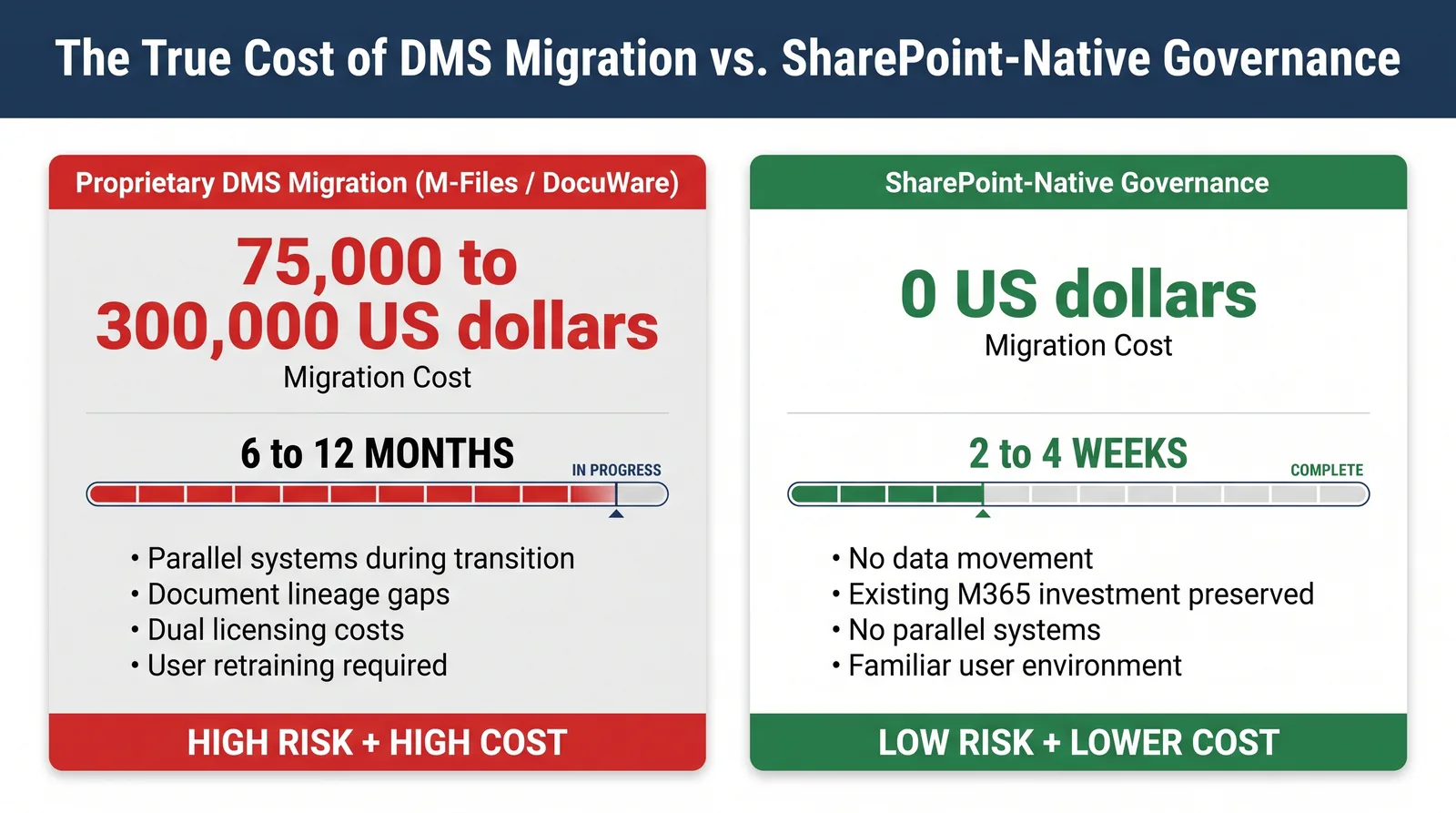
- Dedicated DMS platforms often require full migration projects in the $75,000 to $300,000 range over 6 to 12 months.
- A third path exists: SharePoint-native governance that adds enterprise controls without moving files.
- Total cost of ownership matters more than headline licensing fees once migration and retraining are included.
- The right choice depends on current platform posture, compliance requirements, and migration tolerance.
The Three Approaches to CRE Document Management
Most comparisons cover only two options. In practice, CRE teams evaluate three.
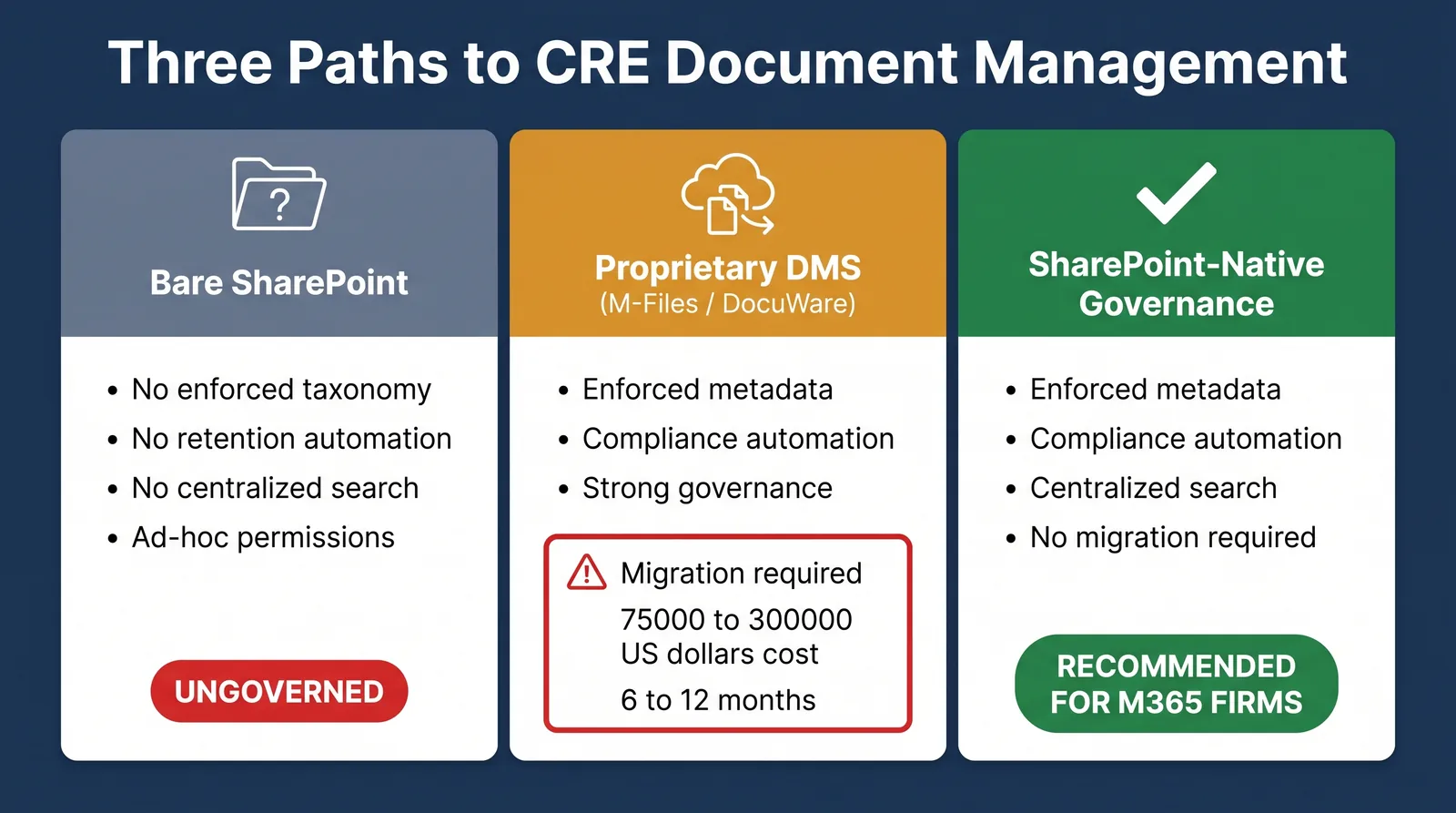
Approach 1: Native SharePoint with no governance. The firm uses SharePoint as-is with inconsistent foldering and user-dependent habits.
Approach 2: Proprietary DMS with full migration. The firm migrates content into a vendor cloud such as M-Files or DocuWare.
Approach 3: SharePoint-native governance layer. The firm keeps files in SharePoint and adds enforced metadata, provisioning, retention, and audit controls.
This third approach is why the decision is no longer a forced binary.
What Dedicated DMS Platforms Actually Get You
Dedicated DMS platforms provide strong metadata workflows, governance controls, and compliance-oriented automation.
M-Files is known for metadata-driven retrieval and workflow depth. DocuWare is strong in process-heavy workflows such as approvals and document routing.
The hidden factor is migration. For many CRE organizations, migration services represent the dominant cost and timeline driver before users experience value.
Full Feature and Cost Comparison Table
| Dimension | Bare SharePoint | Proprietary DMS | SharePoint-Native Governance |
|---|---|---|---|
| Data migration required | No | Yes | No |
| Migration cost | $0 | $75,000-$300,000+ | $0 |
| Time to go live | Days, ungoverned | 6-12 months | 2-4 weeks |
| Enforced metadata | No | Yes | Yes |
| Centralized cross-library search | Limited | Yes | Yes |
| Vendor lock-in risk | Low | High | Low |
| Estimated 2-year TCO | Low license, high labor waste | Very high | Moderate |
Four CRE Buyer Profiles Mapped to the Right Solution
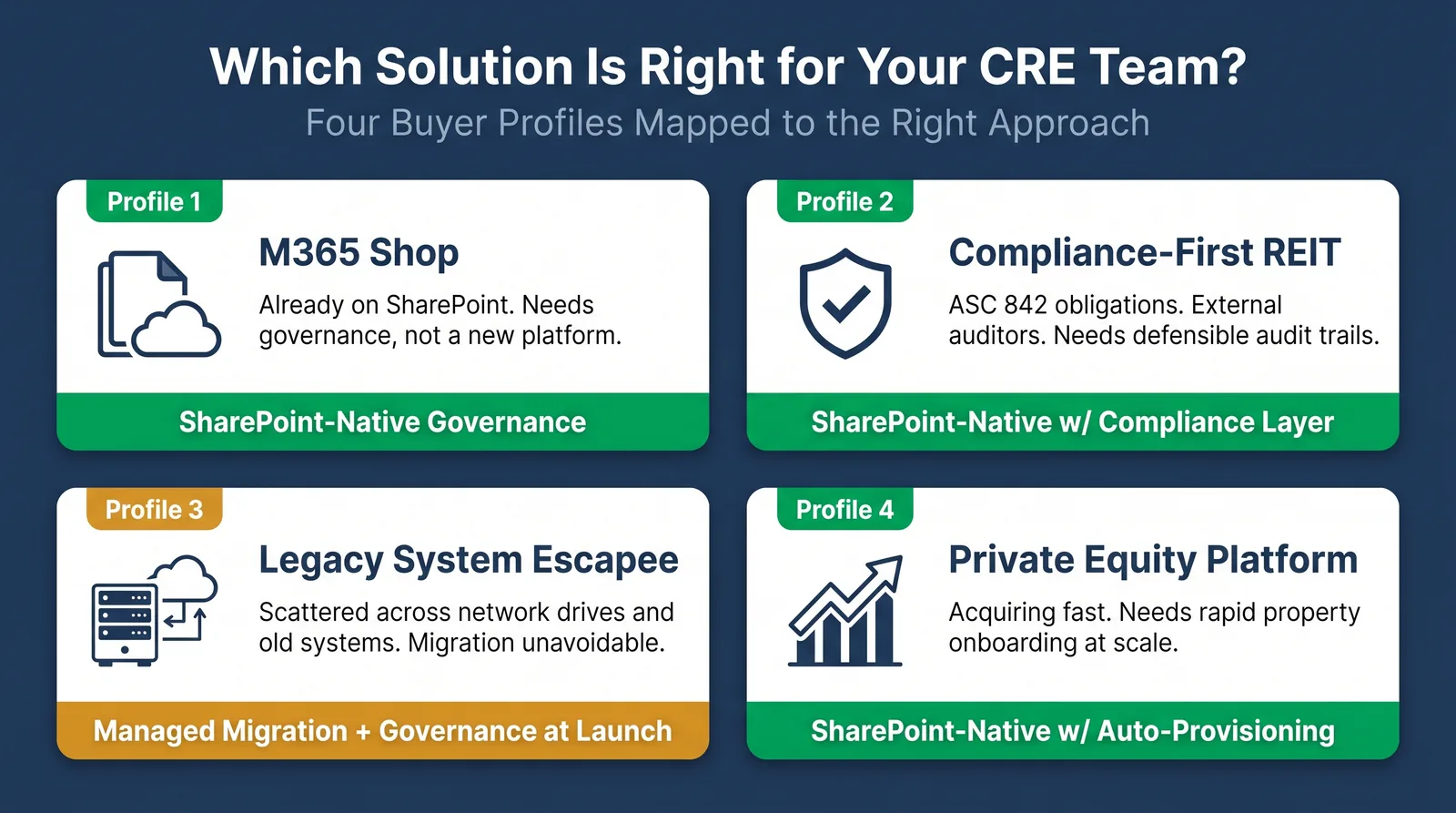
Profile 1: The Microsoft 365 Shop
Already on Microsoft 365 with content in SharePoint. Needs governance controls more than a new repository.
Profile 2: The Compliance-First REIT
Requires strong audit and retention outcomes. SharePoint-native governance is often best when M365 investment already exists.
Profile 3: The Legacy System Escapee
Needs consolidation from fragmented legacy storage. Migration to SharePoint Online plus immediate governance is often the cleanest path.
Profile 4: The Private Equity Platform
Needs rapid property onboarding and templated governance as acquisitions scale.
The Migration Risk Most CRE Teams Underestimate
During long migration windows, teams run two systems simultaneously, absorb duplicate licensing exposure, and rebuild permission structures while still supporting live operations.
Document lineage is often the hidden issue. Version history, sharing history, and prior access context do not always transfer in a form acceptable for compliance and litigation workflows.
The most expensive outcome is beginning migration, stalling midstream, and ending up with two incomplete systems.
How to Make the Final Call
- Confirm whether you already have a strong Microsoft 365 foundation.
- Assess real operational tolerance for a 6-12 month parallel-system migration period.
- Map compliance requirements to concrete capabilities: retention automation, audit evidence, and reporting.
For most firms already on Microsoft 365, governance on existing SharePoint infrastructure provides better speed-to-value and lower execution risk than full proprietary migration.
Book a 30-minute ARC-Files demo to see this model in your current environment.
Frequently Asked Questions
Is SharePoint a good document management system for commercial real estate?
Yes, when governance is enforced. Out of the box, SharePoint lacks the controls enterprise CRE teams require for scale and compliance.
How much does migration to M-Files or DocuWare usually cost?
For many mid-market CRE firms, managed migration services range from about $75,000 to $150,000, with higher enterprise programs exceeding that significantly.
Can SharePoint replace a dedicated DMS for real estate compliance?
With a proper governance layer, yes. The key requirements are policy automation, audit trail integrity, and consistent metadata enforcement.
What is the vendor lock-in risk with proprietary DMS platforms?
When files and metadata are moved into a proprietary repository, future platform changes can require another large migration project.
How long does SharePoint-native governance typically take to implement?
Well-scoped implementations commonly reach operational readiness in 2 to 4 weeks because data migration is avoided.
The Bottom Line
The best-performing CRE teams in 2026 are not choosing between two extremes. They are applying governance to the SharePoint foundation they already own.
This avoids migration drag while delivering enterprise controls for search, retention, permissions, and compliance reporting.
Keep reading
Suggested Articles
Continue exploring document management, SharePoint governance, and compliance for commercial real estate teams.