Real Estate Management Software in 2026: The Document Governance Layer Every Portfolio Is Missing
Why real estate management software does not govern documents, what a proper governance layer needs, and how to add it without replacing your existing platform or stack.
Published August 15, 2026 · By ARC-Files · 18 min read
Published: August 15, 2026 | By ARC-Files
Real estate management software is everywhere. Every serious real estate team runs at least one platform. Yardi. MRI. AppFolio. Salesforce. These tools manage rent rolls, track maintenance, handle accounting, and run investor reporting. They do all of that well.
But none of them govern documents.
That gap rarely shows up in a vendor demo. It does not surface in most buying reviews. However, it becomes painfully clear when a team faces an investor audit, a contested lease renewal, or a multi-state compliance check. At that point, the real estate management software running your operations has a document problem — and it gets more expensive every year.
This article is for real estate technology leaders who already know they have a document problem. The question is not whether the problem exists. The question is this: do you need a new platform, or do you need a governance layer added to what you already own?
Key Takeaways
- Real estate management software stores documents but does not govern them. Metadata enforcement, retention automation, and audit-ready trails are not what these systems were built for.
- Four workflows generate the highest document chaos cost: property acquisitions, lease renewals, institutional investor audits, and multi-market portfolio operations.
- A proper document governance layer needs four things: enforced metadata, automated retention by document type, a full tamper-evident audit trail, and zero-migration integration with your existing stack.
- SharePoint-native governance closes the gap without requiring teams to migrate away from Microsoft 365 or manage a separate document silo.
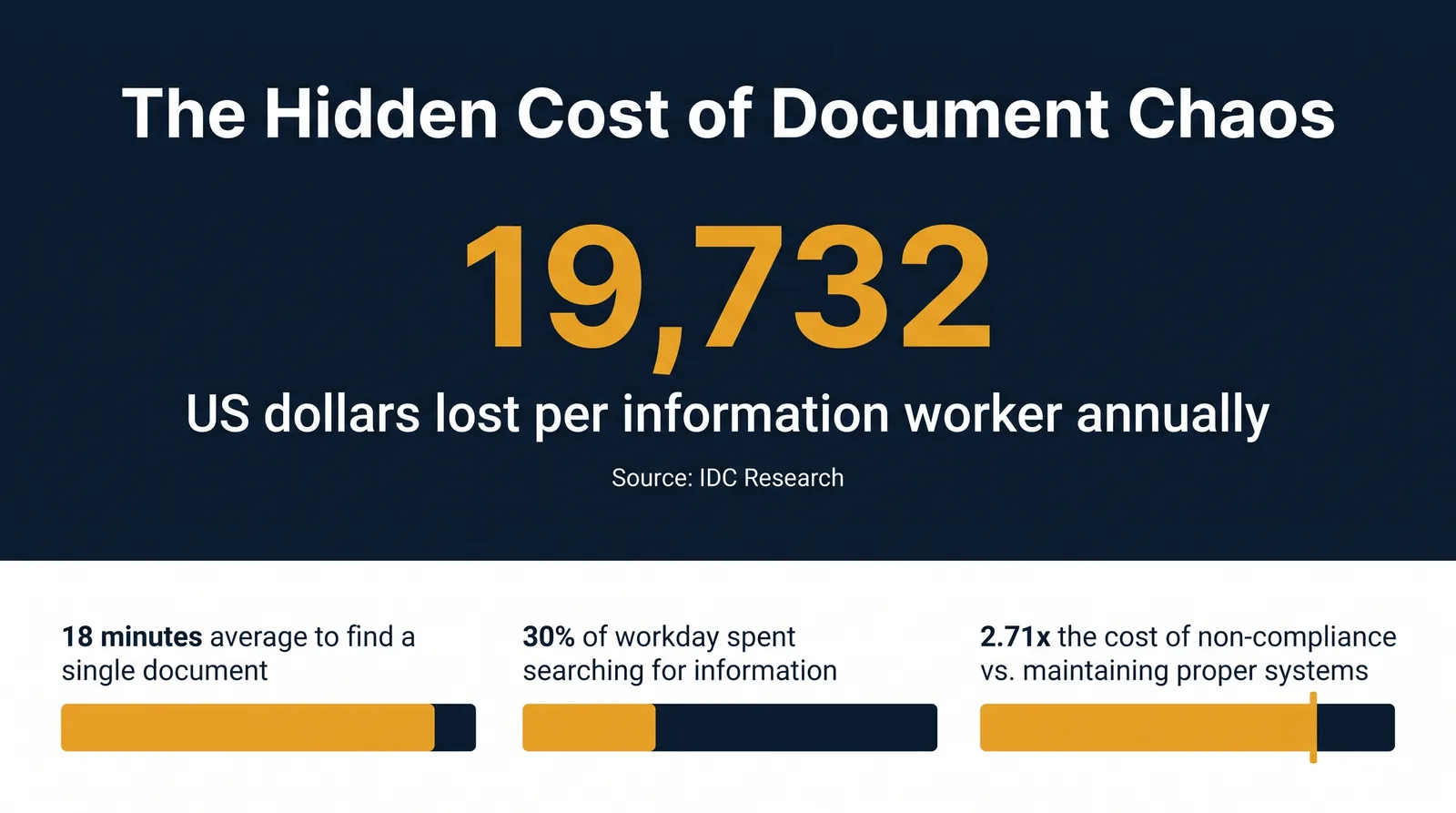
- The cost of inaction is real: according to IDC research, poor document management costs organizations an average of $19,732 per information worker per year.
What Real Estate Management Software Is Actually Designed to Do
Real estate management software is built to coordinate property operations. It handles leasing, accounting, maintenance, tenant communication, and portfolio reporting. Platforms like Yardi Voyager, MRI Property Management, and AppFolio handle this work well. When a property manager needs to collect rent, track a work order, or reconcile CAM charges, these platforms deliver.
However, none of that overlaps with document governance.
Document governance means making sure every document is correctly labeled, version-controlled, kept for the legally required period, and ready to produce on demand. It answers questions like:
- Which version of this lease amendment was actually signed, and who approved it?
- Where is the environmental report for the Oak Street acquisition — and who accessed it during due diligence?
- When does the insurance certificate for the Phoenix portfolio expire, and is there an automated reminder?
- Which documents across all 47 properties are past their retention date?
Real estate management software does not answer these questions. That is not a design flaw. Operations coordination and document governance are simply different problems. However, treating one as a substitute for the other creates serious compliance exposure inside most enterprise real estate portfolios.
The global property management software market is valued at $7.1 billion in 2025. It will reach $17.1 billion by 2035. Additionally, document governance is treated as a secondary feature across the entire market. It gets listed as a checklist item rather than a core capability.
The Document Gap Hiding in Every Major Real Estate Management Software Platform
The most common misconception in real estate technology is this: "We store leases in Yardi, so our document management is handled."
Storing documents and governing documents are not the same thing.
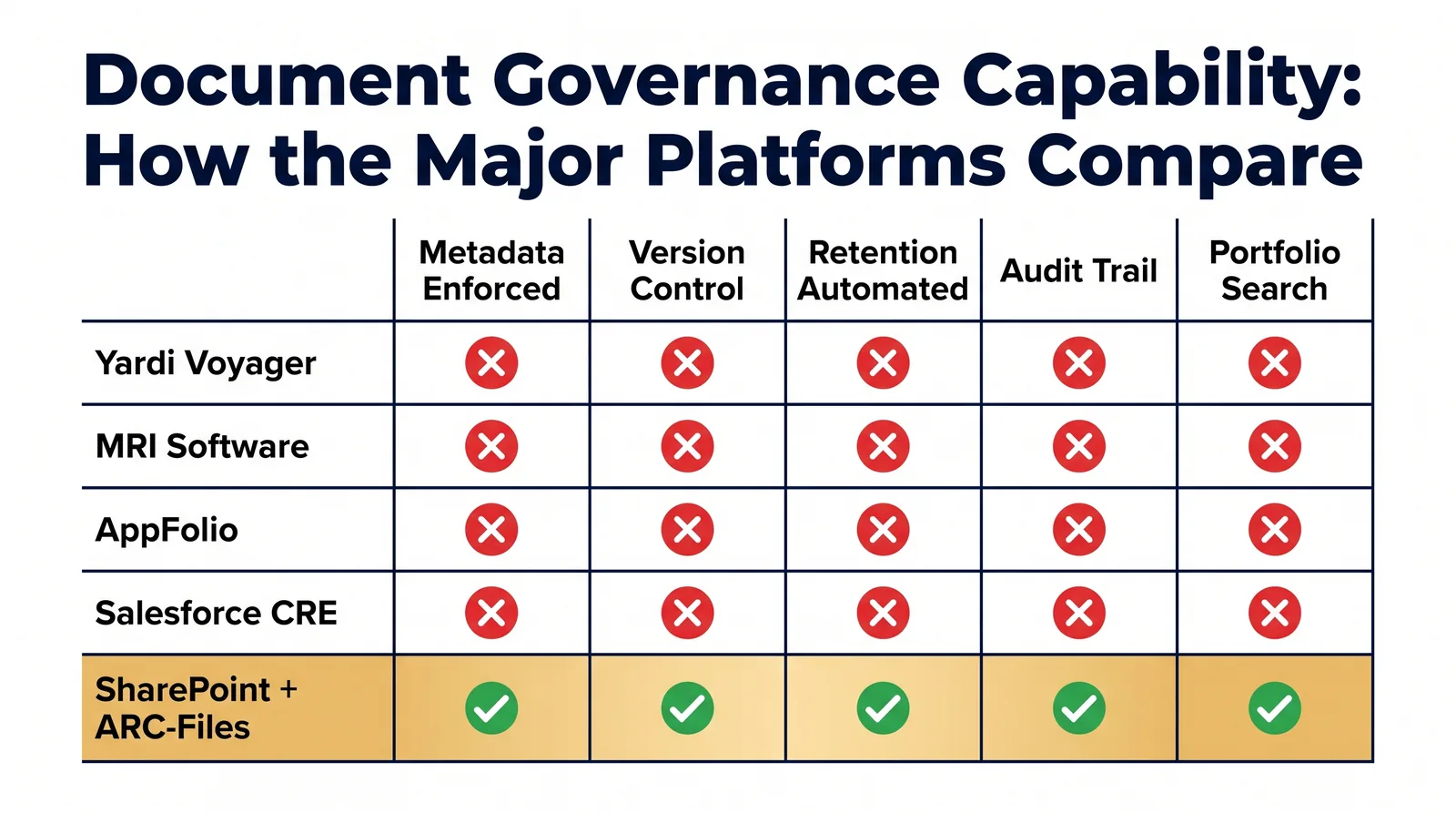
| Platform | Storage | Metadata | Retention | Audit Trail |
|---|---|---|---|---|
| Yardi Voyager | Yes | Optional | No | Limited |
| MRI Property | Yes | No | Manual | Limited |
| AppFolio | Yes | No | No | Minimal |
| SharePoint + ARC-Files | Yes | Enforced | Automated | Full |
The pattern is clear. Every platform stores documents. However, none of the major real estate management software platforms enforce governance. SharePoint gets closer than most — it has version history and optional metadata fields. But it needs careful setup and ongoing maintenance to reach real governance capability.
The Four Workflows Where Document Chaos Costs Real Estate Teams the Most
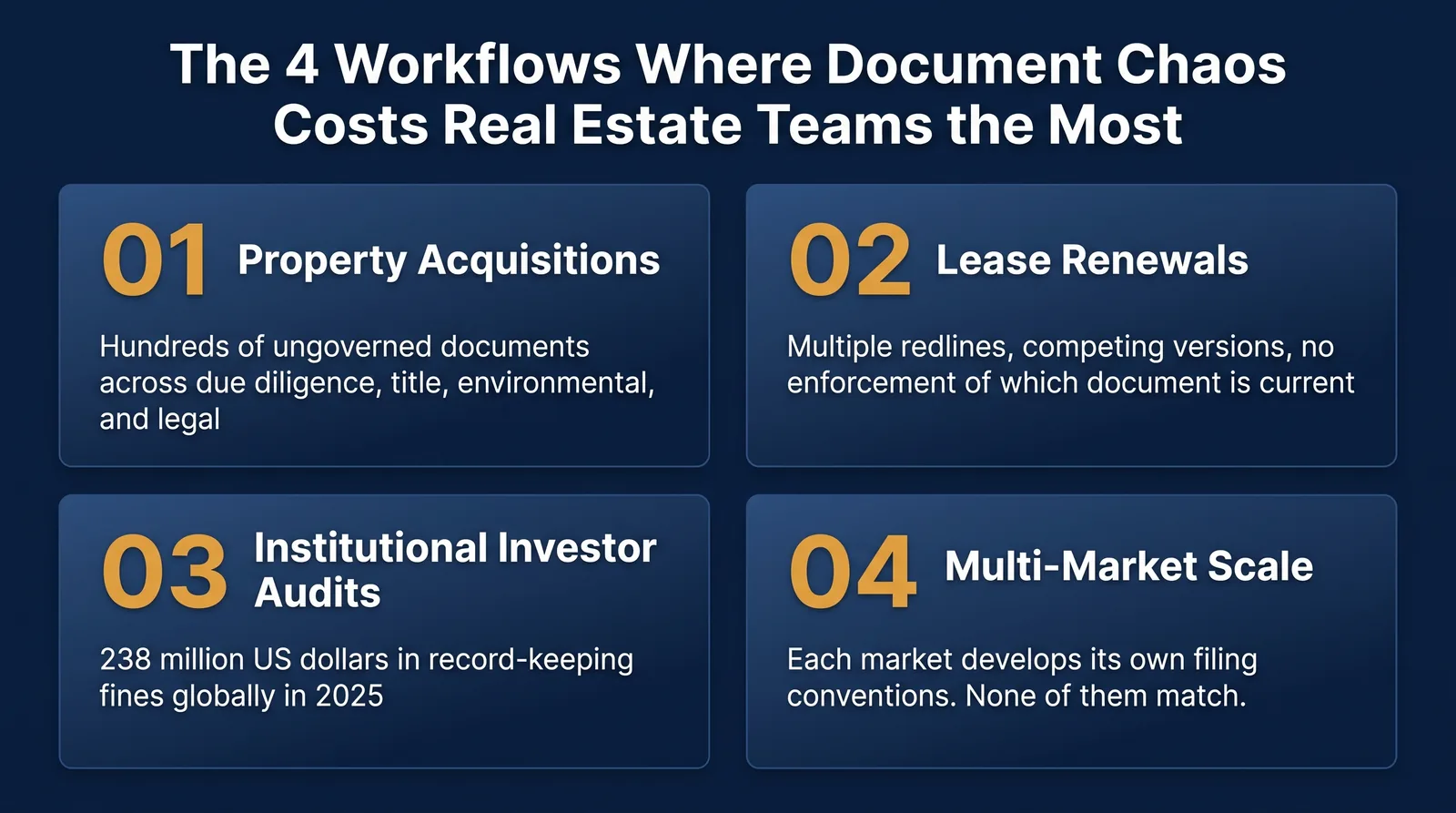
Document governance failures do not appear evenly across all workflows. They concentrate in four specific areas where the stakes are highest and document complexity is greatest.
1. Property Acquisitions
An acquisition generates hundreds of documents spanning due diligence, title, environmental, zoning, rent rolls, lease abstracts, and inspection reports. These arrive from many parties with no standard naming. After closing, whether they are correctly labeled, version-controlled, and ready to produce on demand is a separate question entirely.
2. Lease Renewals
Lease renewals produce multiple redlines, competing versions, and broker correspondence that can override earlier terms. The failure here is quiet: the wrong version of a lease amendment gets executed because no one enforced which document was current. IDC research shows finding a single document takes an average of 18 minutes in informal document environments.
3. Institutional Investor Audits
This is where governance failures become most visible and most expensive. Large institutional investors conduct regular audits requesting executed leases, insurance certificates, environmental reports, and proof of retention compliance. Teams without governance spend two to three weeks pulling files from six different systems and often still cannot produce a complete record.
4. Multi-Market Scale
At multi-market scale, informal document conventions break down. Different markets build different folder structures. Different administrators create different metadata schemes. State-specific retention rules vary by location and rarely get tracked. The portfolio ends up with documents that exist but cannot be reliably found.
What a Proper Document Governance Layer Must Include
If real estate management software does not provide document governance, what does a proper governance layer actually need? Four capabilities are required.
Enforced Metadata at Upload
Metadata enforcement means the system requires documents to be tagged with correct classification fields before they can be saved. These are not optional fields. They are required fields. When metadata is optional, it does not get filled in consistently. When it is enforced, the document library becomes searchable by any field across every property and market without manual cleanup.
Automated Retention by Document Type
Manual retention management does not scale. Every document type gets a retention schedule. The system enforces these schedules without manual steps. Documents near their retention date trigger review workflows. Documents approved for deletion are removed with a full audit record. This protects teams on both ends of the retention timeline.
Full, Tamper-Evident Audit Trails
An audit trail records who accessed a document, when, what they did to it, and what version they were working from. The audit trail must be tamper-evident, complete, and organized for review. Auditors must be able to pull a document history report without IT involvement.
Zero-Migration Integration
The governance layer must connect to existing real estate technology without requiring a platform migration. A SharePoint-native governance layer avoids migration risk entirely. Documents stay in Microsoft 365. Governance controls apply on top. The real estate management software continues to work as it always has.
How to Add a Governance Layer Without Replacing Your Stack
The real question for real estate technology leaders is how to add governance without triggering a platform replacement project or a six-month IT rollout.
The answer is a phased approach organized by document risk level.
Phase 1: Active Leases and Current Contracts (Weeks 1–6)
Start with documents that carry the highest active risk: executed lease agreements, current contracts, active insurance certificates. Metadata enforcement activates for these document types. Retention schedules go live. Audit trail logging begins. The goal is to stop adding ungoverned documents to the pile.
Phase 2: Acquisition and Disposition Records (Weeks 6–12)
The second priority is deal-related documents: acquisition due diligence files, purchase agreements, environmental reports, and disposition records. Existing deal files move into the governed structure property by property with metadata applied during migration. This is a labeling exercise, not a lift-and-shift operation.
Phase 3: Historical Archive and Cross-Market Consistency (Months 3–6)
The final phase addresses historical documents and sets consistent governance standards across all markets. After this phase, the portfolio has a full governance layer across every market, property type, and document category. No existing platform gets replaced in the process.
Frequently Asked Questions
What is real estate management software?
Real estate management software is a digital platform that centralizes and automates the daily tasks of managing a property portfolio. This includes rent collection, lease tracking, maintenance management, tenant communication, and financial reporting. Platforms like Yardi, MRI, and AppFolio coordinate day-to-day property operations. However, they are not document management systems in any compliance sense, even though they do store documents as part of their operational workflows.
What is the difference between real estate management software and document management software?
Real estate management software handles operations: rent rolls, work orders, accounting, and tenant portals. Document management software governs the documents those operations produce — enforcing metadata, automating retention, maintaining audit trails, and enabling cross-portfolio search. Most enterprise real estate teams need both. However, most currently have only the first.
Does real estate management software handle document governance?
No major real estate management software platform provides real document governance as a native feature in 2026. Platforms like Yardi and MRI store documents and offer basic version history. However, metadata enforcement is typically optional, retention automation is not built in, and audit trails are not organized for regulatory review. Governance requires a dedicated layer.
What features should I look for in real estate management software for a commercial portfolio?
For commercial portfolios, prioritize platforms that handle multi-tenant lease structures, CAM reconciliation, and solid financial reporting. Then evaluate document governance separately — this is the feature most software reviews overlook. Ask whether metadata is enforced at upload. Ask whether retention schedules run automatically. Ask whether the audit trail produces a document history report without IT involvement.
How does document governance support institutional investor audits?
Institutional investor audits require fast, organized production of documents across a portfolio: executed leases, current insurance certificates, environmental reports, financial disclosures, and proof of ongoing compliance. A governed document layer means all of these records are pre-labeled with property and document metadata and accessible from a single search. Audit response time drops from weeks to hours.
Can I add document governance without replacing my existing real estate software?
Yes — and this is the core argument for SharePoint-native governance over standalone DMS platforms. A governance layer built inside Microsoft 365 connects to Yardi, MRI, AppFolio, and Salesforce without requiring a migration or a parallel document database. Documents stay in the M365 environment your team already uses daily. Governance controls apply on top of that environment.
The Bottom Line
Real estate management software was never designed to be a document governance system. Expecting it to serve that function is the most common technology mistake in enterprise real estate operations.
The workflows where that gap hurts the most are specific and predictable. Acquisitions generate hundreds of ungoverned documents. Lease renewals expose teams to version chaos and legal risk. Institutional investor audits require fast production of a complete document record. Multi-market portfolios collapse under the weight of inconsistent filing conventions.
The cost is not theoretical. IDC research puts the annual cost of poor document management at $19,732 per information worker. For a 20-person operations team, that is nearly $400,000 per year in lost productivity and compliance exposure.
The solution is not a new platform. It is a governance layer. That layer enforces metadata at upload, automates retention by document type, and maintains a tamper-evident audit trail. It integrates with the real estate management software already running your operations. No migration. No disruption.
A SharePoint-native approach delivers all of this inside the Microsoft 365 environment most real estate teams already use. The documents stay where they are. The governance controls go on top. The audit readiness that used to take two weeks of manual preparation becomes a standard report that runs in minutes.
ARC-Files is built specifically for real estate and construction portfolios that need this governance layer. It works without replacing any existing platform. If your team knows it has a document problem but has not found a solution that fits your stack, ARC-Files is worth a direct look.
The property management software market grows at 9.3% per year. However, the gap between what real estate management software handles and what document governance requires is not closing on its own. It can be closed in months — on the infrastructure you already own.
Keep reading
Suggested Articles
Continue exploring document management, SharePoint governance, and compliance for commercial real estate teams.