Real Estate Document Compliance: How CRE Teams Stay Audit-Ready Year-Round
Enterprise CRE teams face overlapping compliance frameworks: ASC 842, IFRS 16, SEC disclosure rules, and state retention laws. Build the document infrastructure that makes audit-ready a continuous state, not a seasonal scramble.
Published July 27, 2026 · By ARC-Files · 16 min read
Published: July 27, 2026 | By ARC-Files
Every CRE compliance team knows the feeling: the auditor email arrives, and the next two weeks become a document hunt. Files pulled from personal drives, emails forwarded with crossed fingers, version histories assembled manually from timestamps and vague file names. By the time you hand the package over, you've spent 80 hours of professional time that should have been zero.
Real estate document compliance doesn't have to work this way. The organizations that stay audit-ready year-round aren't working harder during audit season — they've built the right infrastructure so that audit season looks no different from any other week.
This guide covers the compliance frameworks facing enterprise CRE teams in 2026 — ASC 842, IFRS 16, SEC reporting obligations, and state retention laws — and the five document environment components that determine whether your team scrambles or simply opens a folder.
Key Takeaways
- Real estate document compliance in 2026 means satisfying at least four overlapping regulatory frameworks simultaneously: ASC 842, IFRS 16, SEC disclosure rules, and state-specific retention laws.
- According to a Ponemon Institute study, the cost of non-compliance is 2.71 times higher than the cost of maintaining proper compliance systems — making governance investment straightforwardly economical.
- Record-keeping failures alone contributed approximately $238.5 million in fines globally in 2025, separate from broader non-compliance penalties.
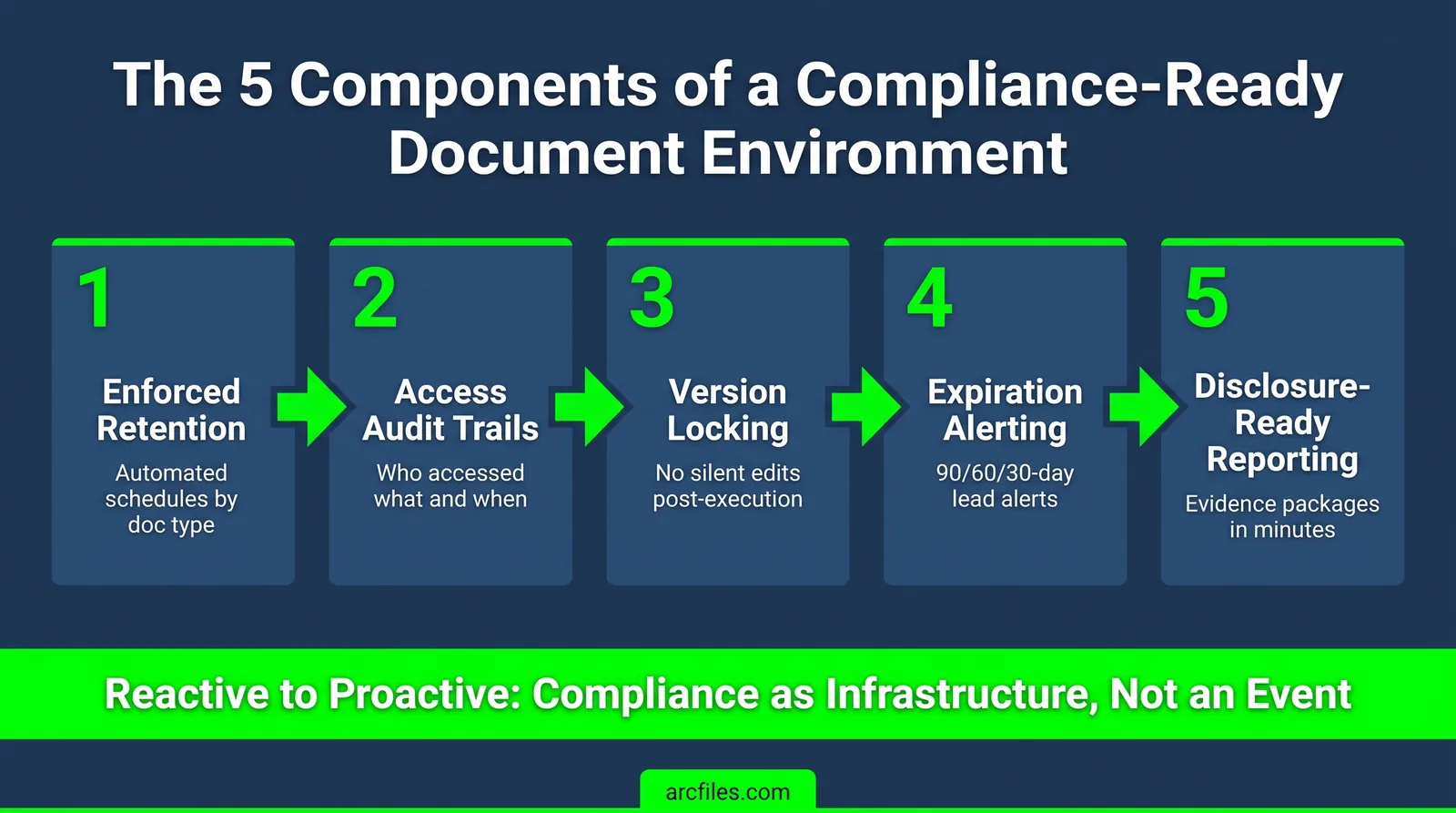
- A compliance-ready document environment has five specific components: enforced retention schedules, access audit trails, version locking, expiration alerting, and disclosure-ready reporting packages.
- The shift from reactive to proactive compliance isn't a process change — it's an infrastructure change. The right document environment makes compliance a continuous state, not a quarterly fire drill.
The Compliance Pressure Facing Enterprise CRE Teams in 2026
Enterprise CRE compliance has never been more complex. In 2026, a typical REIT or large private CRE firm is simultaneously managing obligations under multiple overlapping frameworks — and the documentation each one demands is specific, traceable, and time-sensitive.
The global lease management software market reached $5.7 billion in 2024 and is projected to grow to $8.1 billion by 2030, according to Grand View Research. That growth reflects the volume of compliance pressure driving adoption. Organizations aren't buying lease management tools because they want more software — they're buying them because manual processes can no longer absorb the documentation burden.
What makes real estate document compliance distinctively hard is that it operates across three axes at once:
- Regulatory axis: Federal standards (ASC 842, IFRS 16, SEC rules), state retention laws, and IRS documentation requirements all apply concurrently and sometimes conflict.
- Operational axis: Compliance requirements touch every document category — executed leases, amendments, insurance certificates, environmental reports, board minutes, lender agreements, and more — not just one document type.
- Temporal axis: Retention requirements span years or decades, while expiration tracking and disclosure deadlines operate on a quarterly or annual cycle.
No team manages this well manually at scale. The organizations that get it right have built systems that make compliance structural, not incidental.
What "Audit-Ready" Actually Means (Most Teams Get This Wrong)
Audit-ready means your documents are complete, traceable, and retrievable in minutes — without a special effort triggered by the audit notice.
Most CRE teams define audit-ready as "we can find everything the auditor needs eventually." That definition leads to exactly the scramble described above. True audit readiness is a document environment property, not a team behavior.
Here's what auditors actually test for when they review CRE document compliance:
- Completeness: Is every required document present for each lease, property, and period under review?
- Integrity: Have documents been modified after execution, and is there a record of any changes?
- Traceability: Who accessed each document, when, and what did they do with it?
- Retention: Has the organization retained documents for the required period under applicable law?
- Version currency: Are disclosed versions of documents current, or has a superseded version been submitted?
An audit-ready document environment answers all five questions automatically, because those answers are embedded in the system itself. The audit trail exists whether or not anyone is watching.
Teams that confuse "we have the documents" with "we have a defensible audit trail" typically discover the difference at the worst possible moment.
The Four Compliance Frameworks Every CRE Team Must Understand
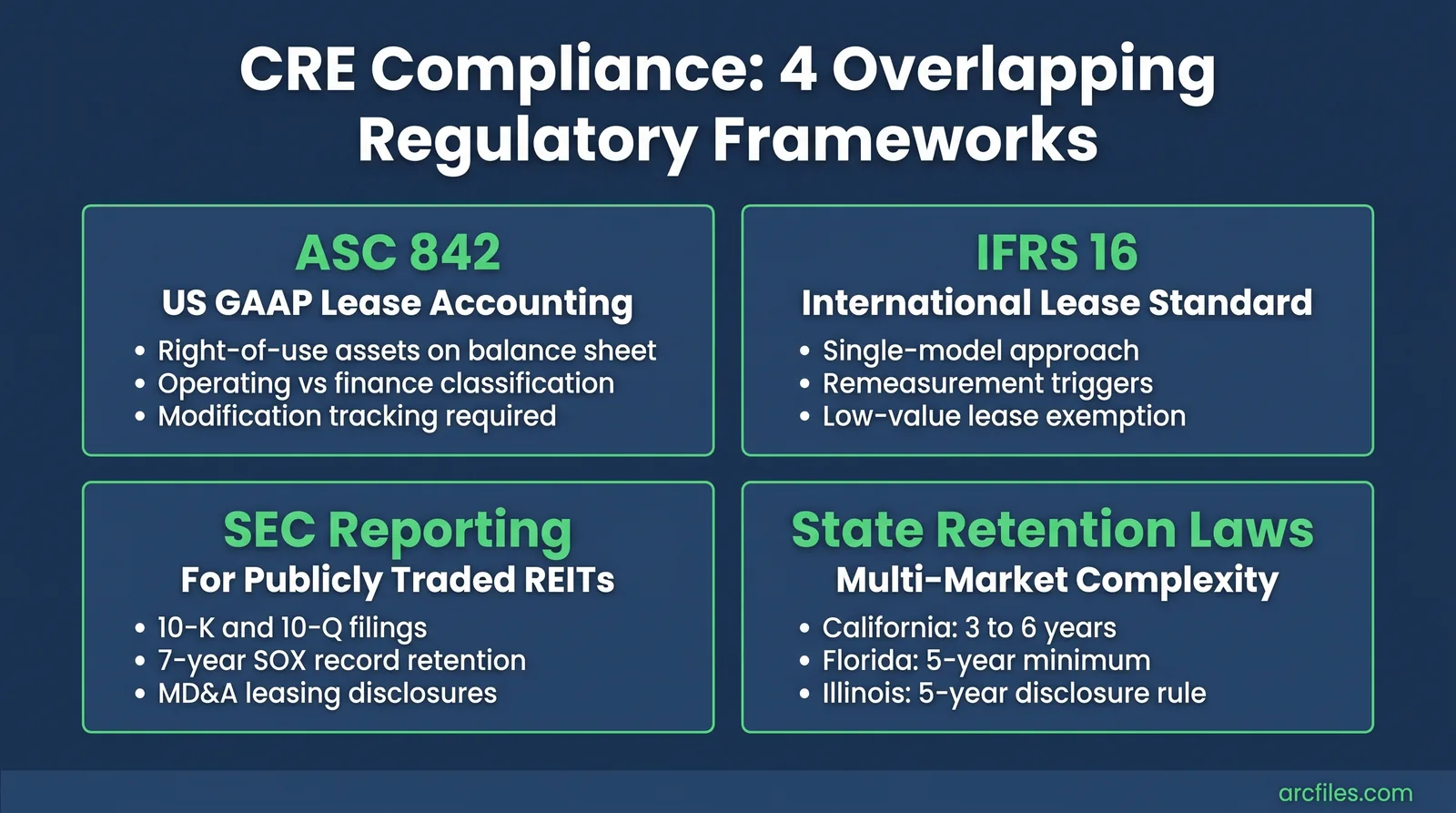
Real estate document compliance is not a single standard. It's a stack of overlapping obligations. Most enterprise CRE teams need to satisfy all four of the following simultaneously.
ASC 842: Lease Accounting Under US GAAP
ASC 842, effective for public companies since 2019 and private companies since 2022, fundamentally changed how leases appear on financial statements. Under ASC 842, most operating leases must now be recognized on the balance sheet as right-of-use (ROU) assets and corresponding lease liabilities.
From a documentation standpoint, ASC 842 compliance requires:
- Complete lease population data: Every lease — including embedded leases in service contracts — must be identified and catalogued.
- Modification tracking: When lease terms change, the modification must be documented, dated, and tied to revised ROU asset calculations.
- Classification evidence: Documentation must support each lease's classification as operating or finance.
- Renewal option documentation: If a renewal option is reasonably certain to be exercised, that judgment must be supported by documented business rationale.
IFRS 16: The International Standard
IFRS 16, effective since 2019, takes a single-model approach: nearly all leases are treated similarly to finance leases under ASC 842. This means higher reported EBITDA than under ASC 842 for organizations with significant operating leases.
For internationally active CRE firms and REITs with cross-border holdings, managing documentation under both ASC 842 and IFRS 16 compounds complexity significantly:
- Remeasurement triggers: IFRS 16 requires remeasurement of lease liability when an index or rate changes, creating more frequent documentation events than ASC 842.
- Low-value lease exemption: IFRS 16 provides an exemption for leases of low-value assets (typically under $5,000); ASC 842 does not.
- Sublease classification: IFRS 16 bases sublease classification on the right-of-use asset itself, often resulting in more finance lease classifications.
SEC Reporting Obligations for REITs
Publicly traded REITs file Form 10-K annually and Form 10-Q quarterly. Both require disclosure of material lease terms, concentration risk, and changes to the lease portfolio. Under Section 802 of the Sarbanes-Oxley Act (SOX) and SEC Rule 2-06, accounting firms auditing REITs must retain workpapers and audit-relevant records for seven years.
The documents that most frequently trigger SEC comment letters for real estate entities include lease abstracts, modification records, board minutes, and correspondence supporting renewal option probability judgments.
State-Specific Document Retention Laws
Federal compliance frameworks don't preempt state retention requirements, and the state rules are specific:
- California: Licensed real estate brokers must retain transaction records for three years; industry practice recommends six.
- Florida: Transaction records must be preserved for at least five years from receipt of funds or execution of the relevant agreement.
- Illinois: Property disclosures must be retained for five years; electronic correspondence for five years.
Multi-market CRE firms managing properties across several states need to apply the most restrictive applicable retention period to each document category — or build state-aware retention policies that apply the right rule to each file based on its origin state.
The 5 Components of a Compliance-Ready Document Environment
Building real estate document compliance infrastructure means getting five things right. Organizations that check all five move from reactive to proactive.
1. Enforced Retention Schedules
Enforced retention means the system applies retention rules automatically, without relying on someone to remember.
A document uploaded to a SharePoint library should immediately inherit a retention period based on its document type, origin state, and applicable regulatory framework. Without automation, retention is a policy on paper. With automation, it's an infrastructure property.
2. Access Audit Trails
An access audit trail records who viewed, edited, downloaded, or shared every document — with timestamps and user identity — without any manual effort.
This is the component most teams underestimate until an auditor or legal proceeding asks a specific question: "Who accessed this lease agreement between January 1 and March 31, and what did they do with it?"
3. Version Locking
Version locking means that once a document reaches a defined state — executed, filed, disclosed — it cannot be modified without creating a new version and a documented approval record.
This matters for two specific reasons: disclosure integrity (ensuring disclosed versions match stored versions) and audit defense (demonstrating documents haven't been altered after execution).
4. Expiration Alerting
Expiration alerting surfaces key dates — lease expirations, insurance renewals, option notice deadlines — before they pass, not after.
An effective system reads key dates from document metadata at upload, configures lead-time alerts, routes alerts to the right role, and logs alert delivery for audit purposes.
5. Disclosure-Ready Reporting
Disclosure-ready reporting means the document system can generate a structured evidence package — organized by document type, property, or regulatory requirement — on demand.
When an auditor requests lease documentation for 15 properties across three markets, the response should be a governed export from the system, not a manually assembled file. A system-generated package has inherent provenance; an assembled file does not.
Compliance Readiness Assessment: Where Does Your Team Stand?
Use this table to assess your current compliance document environment against the five components. Score each area honestly.
| Component | Reactive (1) | Partial (2) | Proactive (3) |
|---|---|---|---|
| Retention Schedules | Enforcement depends on individuals | Some document categories have labels | All types have system-enforced retention |
| Audit Trails | No centralized log | Logs exist for some libraries | Complete, tamper-evident logs for all |
| Version Locking | Can be edited anytime | Major documents controlled only | All executed documents locked |
| Expiration Alerting | Tracked in spreadsheets | Manual reminders set for major dates | System-generated alerts with escalation |
| Disclosure Reporting | Assembled manually in days | Some reports available | On-demand reports from system |
13–15: Proactive compliance infrastructure. Your team spends audit time reviewing, not hunting.
9–12: Partial compliance maturity. You have the foundation but gaps exist that create exposure.
5–8: Reactive posture. Compliance events are high-effort and high-risk. Infrastructure investment should be a priority.
Why Reactive Compliance Is the Most Expensive Way to Stay Compliant
Here's the argument most compliance teams aren't making to their CFOs: reactive compliance costs far more than proactive compliance infrastructure.
According to a Ponemon Institute study, the cost of non-compliance is 2.71 times higher than the cost of maintaining proper compliance systems. The cost components of reactive compliance that tend to be invisible include:
Direct costs of non-compliance:
- Record-keeping failures contributed approximately $238.5 million in fines globally in 2025
- The average eDiscovery case exceeds $2 million, with over-retained, unorganized records dramatically increasing exposure
- Finding a single misfiled document costs approximately $120 in labor; recreating a lost document costs approximately $220
Indirect costs of reactive compliance:
- Professional time diverted to document assembly during audit windows (40–100 hours per event for mid-size CRE)
- Delayed closings when due diligence documents can't be produced on timeline
- Lender relationship friction when covenant compliance documentation is slow to produce
- Leadership distraction at quarter-end reporting periods
The organizations that invest in compliance infrastructure don't eliminate audit costs entirely. They shift them: from high-effort quarterly scrambles to low-effort continuous operations.
How ARC-Files Builds Compliance Infrastructure Into Your Existing Microsoft 365 Environment
Most document compliance solutions ask you to migrate your documents to a new proprietary system — a 6–12 month project with six-figure implementation costs.
ARC-Files takes a different approach. ARC-Files is a SharePoint-native document management platform built specifically for enterprise real estate teams. It adds governance, compliance automation, and metadata controls directly to your existing Microsoft 365 environment — no migration, no new document silo, no disruption.
For CRE compliance specifically, ARC-Files delivers the five components within SharePoint Online:
- Enforced retention schedules applied at document library level, using Microsoft Purview retention labels governed by ARC-Files' real estate taxonomy
- Complete access audit trails surfaced directly from SharePoint's native audit logging, structured and searchable through ARC-Files' compliance reporting interface
- Version locking applied to executed documents through ARC-Files' document lifecycle controls, preventing post-execution modification without an approval workflow
- Expiration alerting driven by metadata fields (lease end date, insurance renewal date, option notice deadline) with configurable lead times and escalation paths
- Disclosure-ready reporting via ARC-Files' compliance report generator, producing structured evidence packages by property, document type, or regulatory requirement in minutes
Because ARC-Files runs inside your Microsoft 365 tenant, your documents never leave your environment. Your existing permissions, conditional access policies, and IT governance all carry over.
Frequently Asked Questions
What documents must a CRE firm retain for compliance purposes?
Enterprise CRE firms must retain a wide range of documents with retention periods varying by category and jurisdiction. Executed leases and amendments are generally retained for the life of the lease plus 7 years under SOX-influenced frameworks. Board minutes and organizational records are typically permanent. Insurance certificates, environmental reports, and financial records commonly require 5–7 years of post-expiration retention. State laws add requirements on top: California recommends 6 years for transaction records; Florida mandates 5 years from execution; Illinois requires 5 years for property disclosures. Multi-market firms should apply the most restrictive applicable rule to each document category.
How does ASC 842 affect CRE document management requirements?
ASC 842 requires CRE firms to identify all leases — including embedded leases in service contracts — and maintain documentation supporting each lease's balance sheet treatment. Specifically, teams must retain classification evidence (operating vs. finance), modification records tied to revised right-of-use asset calculations, renewal option probability documentation, and lease payment schedules. External auditors test whether the disclosed lease population matches executed agreements and whether modifications are accurately reflected.
What is a defensible audit trail for real estate documents?
A defensible audit trail is a system-generated, tamper-evident log that records every access event for every document — including who accessed it, what action they took, when, and which version they were viewing. For real estate document compliance purposes, a defensible trail must capture user identity (not just IP addresses), action type (view, edit, download, share, delete), precise timestamps, and document version at the time of access. Audit trails assembled manually from email history or file system timestamps do not hold up to regulatory scrutiny.
How long must REITs retain documents for SEC compliance?
REITs should operate under a minimum 7-year retention standard for financial records and audit-related documents, consistent with SOX Section 802 requirements that apply to accounting firms auditing public companies. For investment-adviser-type records, SEC Rule 204-2 requires 5-year retention with the first 2 years readily accessible. Specific document categories — board minutes, organizational records, foundational governance documents — should be retained permanently.
What are the most common real estate document compliance failures?
The most common CRE compliance failures fall into five categories: missing documents from the required lease population (often embedded leases not identified at inception); incomplete modification records that leave ASC 842 ROU asset calculations unsupported; expired documents retained past applicable state retention deadlines; access events that cannot be traced because audit logging was not enabled; and version discrepancies where documents disclosed to lenders or auditors do not match what's stored. Most are structural — they result from document environment design, not individual errors.
Can SharePoint handle CRE compliance requirements on its own?
Out-of-the-box SharePoint can store documents and maintain version history, but it does not provide the governance layer that real estate document compliance requires. Without configuration, SharePoint applies no retention schedules, captures audit logs that are difficult to surface and interpret, enforces no version locking on executed documents, and generates no expiration alerts. Organizations using SharePoint for CRE compliance need a governance layer on top of the platform — one that applies retention policies by document type, structures audit log reporting, and provides disclosure-ready output.
The Bottom Line
Real estate document compliance in 2026 means navigating four overlapping regulatory frameworks simultaneously — ASC 842, IFRS 16, SEC disclosure rules, and state-specific retention laws — while maintaining document environments that are complete, traceable, and retrievable on demand.
The organizations that handle this well haven't found some secret process. They've made a structural decision: compliance infrastructure first, compliance behavior second. When the document environment enforces retention, captures audit trails, locks versions, alerts on expirations, and generates disclosure packages automatically, the team's compliance behavior is mostly a matter of following the system.
The cost argument is clear: according to Ponemon Institute research, non-compliance costs 2.71 times more than compliance. For CRE teams absorbing reactive compliance costs in distributed, invisible ways — document hunts, delayed closings, audit-season all-hands-on-deck — the infrastructure investment case is straightforward.
If your team is ready to move from reactive to proactive real estate document compliance, ARC-Files provides SharePoint-native compliance infrastructure built for enterprise CRE. No migration required. No new document silo to manage. Just governance, audit trails, and disclosure-ready reporting — inside the Microsoft 365 environment you already run.
Book a 30-minute demo to see centralized search, compliance automation, and metadata governance in action.
Keep reading
Suggested Articles
Continue exploring document management, SharePoint governance, and compliance for commercial real estate teams.