What Is a Lease Audit Trail and Why Every CRE Compliance Team Needs One
A practical guide to building a defensible lease audit trail for commercial real estate teams under ASC 842, including required controls, auditor test areas, and a 12-point readiness checklist.
Published August 3, 2026 · By ARC-Files · 17 min read
Published: August 3, 2026 | By ARC-Files
A lease audit trail in commercial real estate is something every compliance team knows they need. However, most teams do not know exactly what it requires until the auditor arrives and asks for it.
If your external auditor asks for the full change history on a lease amendment from 14 months ago, how fast can your team provide who changed it, when, and which version was active during the rent escalation calculation?
If the answer is "a few hours" or "we would have to dig through emails," you do not have a proper lease audit trail. You have a gap. For CRE teams working under ASC 842, IFRS 16, or REIT disclosure rules, that gap becomes an audit finding.
This guide answers the six most common questions about lease audit trails, including what they are, what they must contain, what ASC 842 auditors test for, and why spreadsheets fail.
Key Takeaways
- A lease audit trail is system-generated and tamper-evident. It records access events, changes, approvals, and versions across the full lease lifecycle.
- Audit trails are not activity logs. Activity logs are summaries for users; audit trails are compliance evidence for auditors and legal review.
- ASC 842 audits test traceability. Teams must prove modification history, approval records, discount-rate justification, and access controls.
- Spreadsheets and generic cloud storage are not defensible audit infrastructure. They lack immutability, field-level change history, and structured exports.
- Multi-market CRE teams need governance built into daily operations. The audit trail must be produced continuously, not assembled at audit time.
What Is a Lease Audit Trail in Commercial Real Estate?
A lease audit trail is a chronological, system-generated record of every meaningful action taken on a lease document or lease-accounting record. It captures who acted, what changed, when it happened, and which version was active at that moment.
A defensible audit trail is never assembled manually from email threads. It is created automatically by the system and designed so entries cannot be edited after the fact.
- Identity of the actor (named user account)
- Action type (viewed, edited, downloaded, shared, approved, deleted, restored)
- Precise timestamp (date, time, and timezone)
- Document version active during the action
- Field-level before/after values for edits
- Approval sequence with timestamps
How Is a Lease Audit Trail Different From an Activity Log?
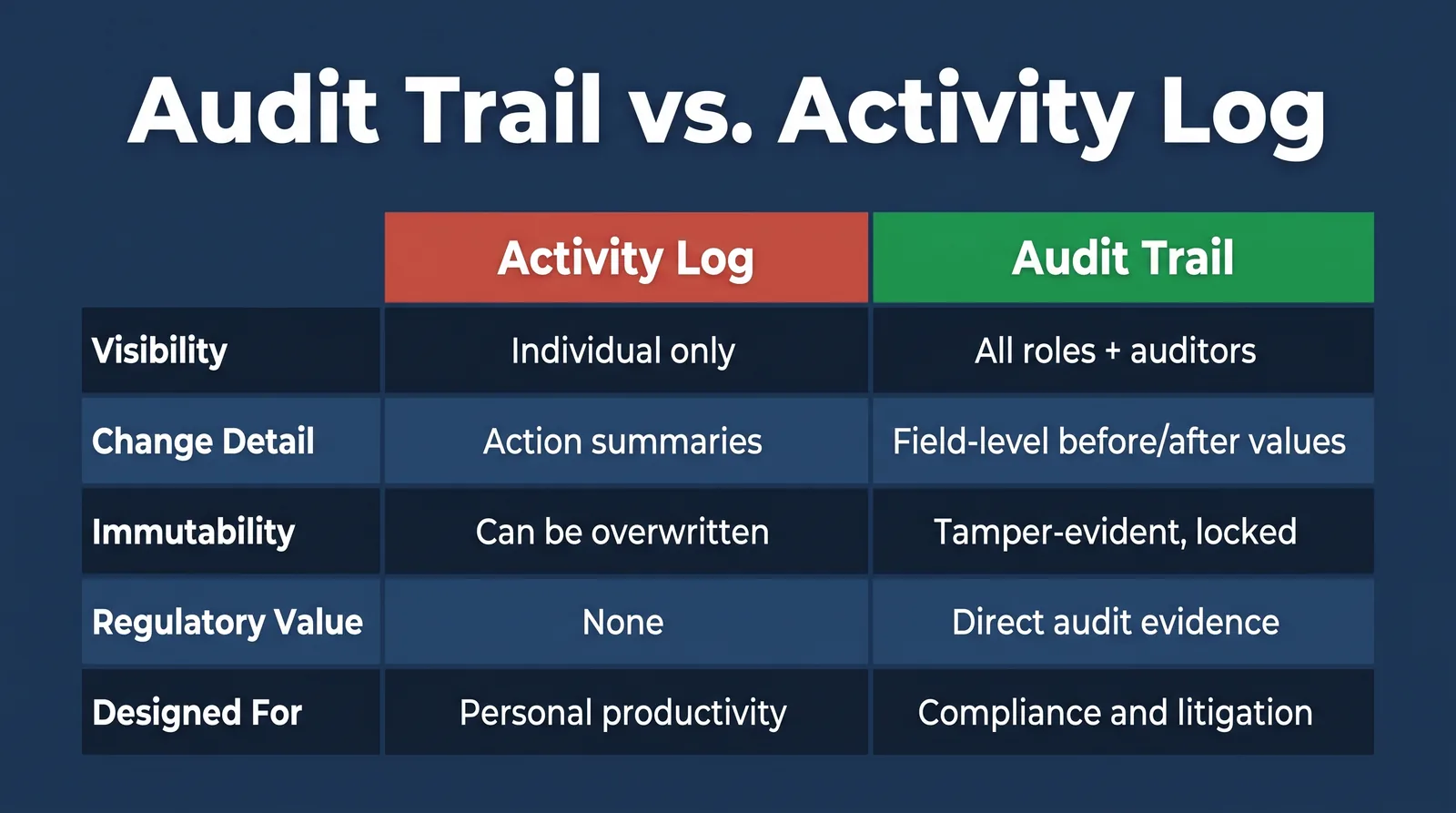
Many teams treat activity logs and audit trails as interchangeable. They are not. Activity logs are user-facing summaries. Audit trails are organization-wide compliance evidence.
| Feature | Activity Log | Audit Trail |
|---|---|---|
| Visibility | Usually individual user | Compliance, audit, and admin roles |
| Change Detail | Action summaries | Field-level before/after values |
| Immutability | Often limited | Tamper-evident and locked |
| Regulatory Value | Minimal | Direct audit evidence |
What Must a Defensible Lease Audit Trail Contain?
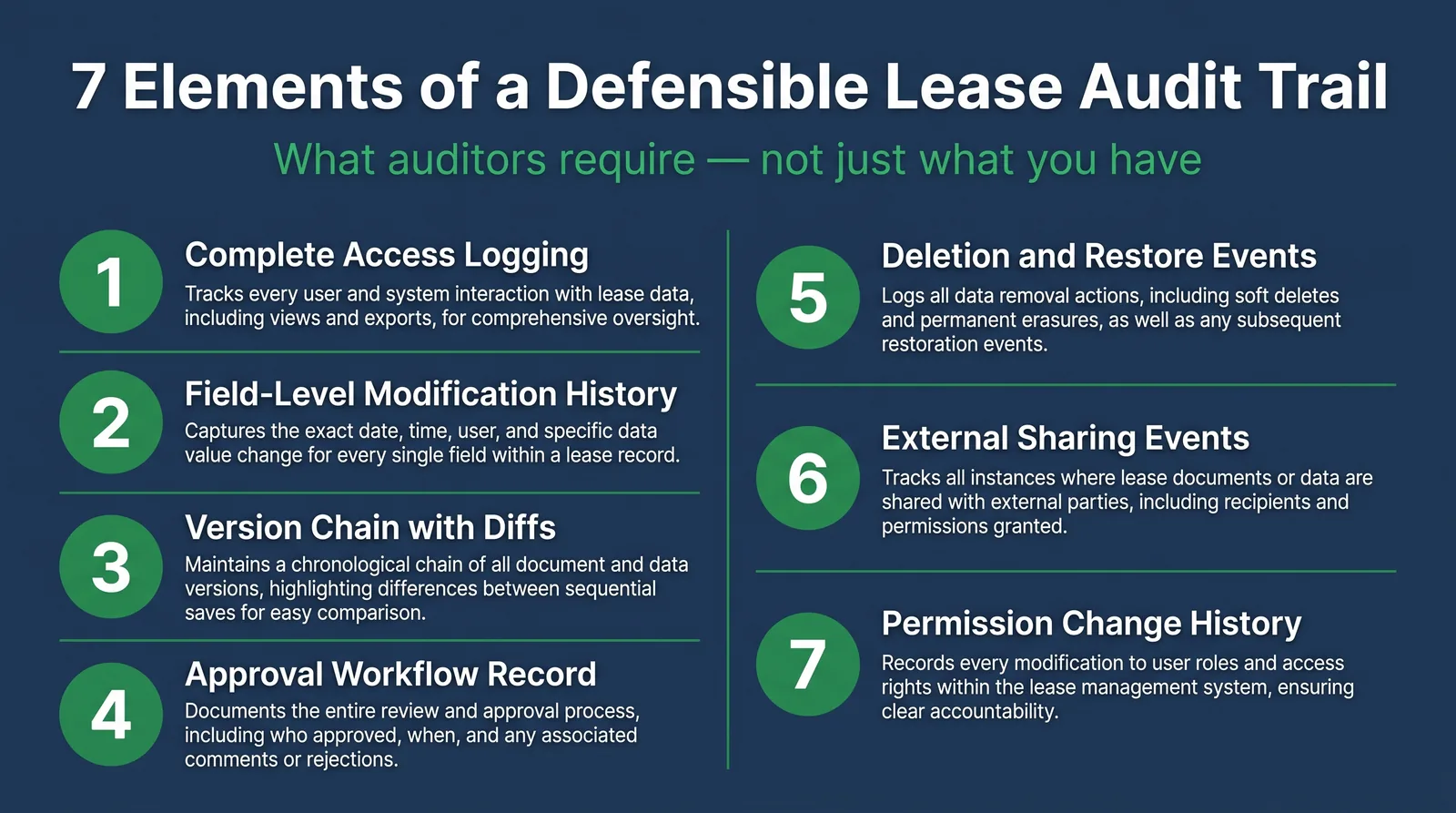
A defensible trail has to hold up under external audit and legal scrutiny. The standard is provenance: complete proof of what happened, who approved it, and when.
- Complete access logging for views, downloads, and prints with named identities.
- Field-level modification history with old and new values.
- Preserved version chain with compare/diff capability.
- Approval workflow record, including sequence, rejections, and escalations.
- Deletion, archive, and restore events with timestamps.
- External sharing history, including recipient and access duration.
- Permission change history proving segregation of duties.
What Do ASC 842 Auditors Test For?
ASC 842 audits follow consistent tests: lease population completeness, modification traceability, discount-rate documentation, reconciliation support, and access-control evidence.
- Completeness testing: Lease lists are cross-checked against GL, vendor records, and embedded lease indicators.
- Modification chain verification: Auditors look for initiation records, treatment analysis, and approval history.
- Discount-rate support: Teams must show method, rationale, and approver for incremental borrowing rates.
- Reconciliation tie-out: Subledger records must tie to GL and footnote disclosures.
- Access control evidence: Role-based permissions and segregation of duties must be provable over time.
Why Do Spreadsheets and Generic Cloud Storage Fail?
This is a design limitation, not a process mistake. Spreadsheets and generic storage were not built for compliance-grade provenance.
- No immutability for historical records.
- No reliable field-level change capture tied to identity governance.
- No complete access-event coverage for long-range audit windows.
- No enforceable approval workflows for controlled changes.
- No structured exports that satisfy auditor evidence requests quickly.
Teams entering audits strongest have a governance layer that captures all trail data by default, rather than relying on ad-hoc manual reconstruction.
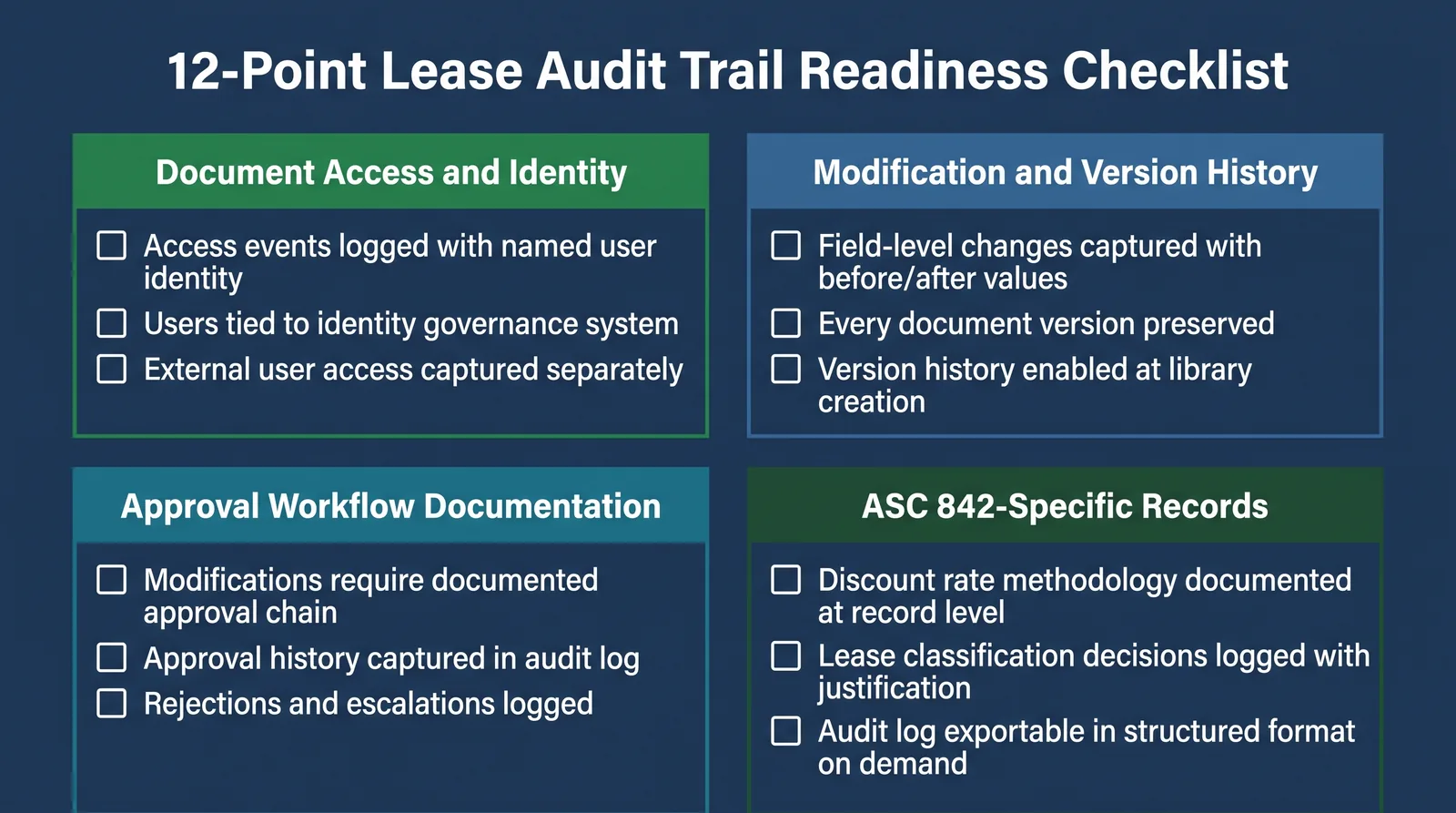
Is Your Team Audit-Ready? 12-Point Checklist
A defensible lease audit trail needs all twelve controls below. Missing items represent measurable audit risk.
- Access events are logged for view, download, and print with named identities and timestamps.
- Identities are tied to your enterprise identity platform, not ad-hoc emails.
- External user events are captured and clearly labeled.
- Field-level changes include before/after values for lease-critical fields.
- Every version is preserved and comparable.
- Version history was enabled from library creation and survived migration activities.
- Lease changes require formal approvals before effective use.
- Approval records include sequence, approver, and timestamp.
- Escalations, rejections, and exceptions are logged with full detail.
- Discount-rate selection and approvals are captured at record level.
- Lease classification decisions are logged with rationale and approver.
- Audit logs are exportable by date range, user, and document on demand.
See how ARC-Files automates access logging, version control, and approval workflows in SharePoint without a migration.Book a demo at arcfiles.com.
What Does Version Control Actually Mean for Lease Documents?
In compliance operations, version control means an unbroken, provable history from executed lease through each amendment, with no silent overwrites.
- Automatic version creation on each save.
- Major/minor versions aligned to approval states.
- Version labels tied to named approvers and timestamps.
- Immutable history with controlled, logged administrative exceptions.
- Conflict-resolution records for concurrent edits.
For ASC 842 reviews, auditors expect to match calculation inputs to the exact lease version active at the time of calculation. Without that linkage, evidence is incomplete.
Frequently Asked Questions
What is the difference between a lease audit and a lease audit trail?
A lease audit is a periodic review event. A lease audit trail is continuous evidence captured every day. The audit is the process; the trail is the proof.
How long should lease audit trail records be retained?
Many teams use a minimum seven-year retention period after lease expiration, with litigation-related records retained until final resolution and ownership-transfer records often retained permanently.
Can SharePoint be used for compliant lease audit trails?
SharePoint can support compliant trails when governance controls are configured correctly. A governance layer is typically required for field-level records, enforced approvals, and structured exports.
What findings are common in ASC 842 lease documentation audits?
Common findings include incomplete modification evidence, unsupported discount-rate decisions, weak subledger-to-disclosure tie-outs, incomplete lease populations, and poor access-control evidence.
Why does a spreadsheet fail as an audit trail?
It lacks immutability, complete field-level change capture, robust access-event logging, and reliable structured exports for auditors.
Who owns lease audit trail integrity in a CRE organization?
Ownership is shared across finance/accounting, property operations, and IT/document governance, with one compliance lead coordinating evidence requests and control reviews.
Conclusion: The Audit Trail Is Infrastructure
The strongest CRE compliance teams do not build audit trails the week the auditor arrives. They build systems that produce audit-grade records as a normal part of daily lease operations.
That shift turns audits from emergency projects into routine evidence exports. It reduces findings, protects disclosure quality, and gives finance, operations, and compliance teams a shared source of truth.
ARC-Files provides that governance layer natively on SharePoint, with centralized search, retention controls, access logging, and version control across lease documents in every market.
See how ARC-Files works: book a 30-minute demo at arcfiles.com.
Keep reading
Suggested Articles
Continue exploring document management, SharePoint governance, and compliance for commercial real estate teams.