Commercial Real Estate Due Diligence Documents: Surviving the 14-Day Closing Window
A practical framework for assembling commercial real estate due diligence documents under compressed timelines, with the seven mandatory categories, retrieval benchmarks, and readiness controls.
Published August 2, 2026 · By ARC-Files · 15 min read
Published: August 2, 2026 | By ARC-Files
The call came on a Monday morning. A competitor had matched the offer on a 180,000-square-foot mixed-use property in Denver. The seller gave both parties 14 days to finish due diligence. The first team to deliver a clean package would win the deal.
The acquisition director at Westbrook Capital sent one request immediately: pull the full commercial real estate due diligence documents package, now.
Four days disappeared into email archives, emergency legal calls, and version confusion. They won the deal, barely. Afterward, the director told her team: "We cannot do that again."
Most CRE teams are one tight deadline away from the same problem.
Key Takeaways
- A typical CRE deal requires 200 to 500 due diligence documents, and complex deals can exceed 1,000.
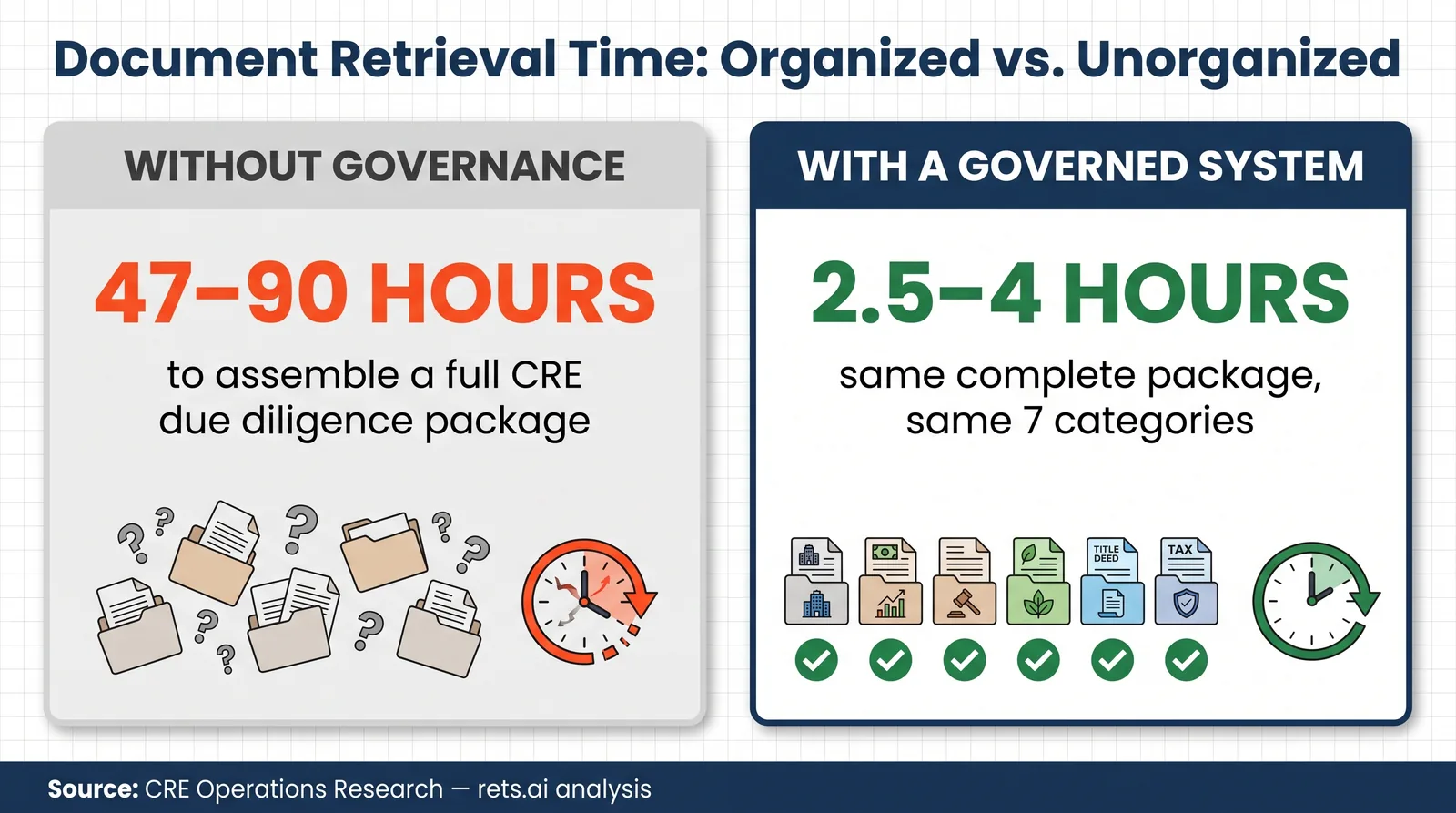
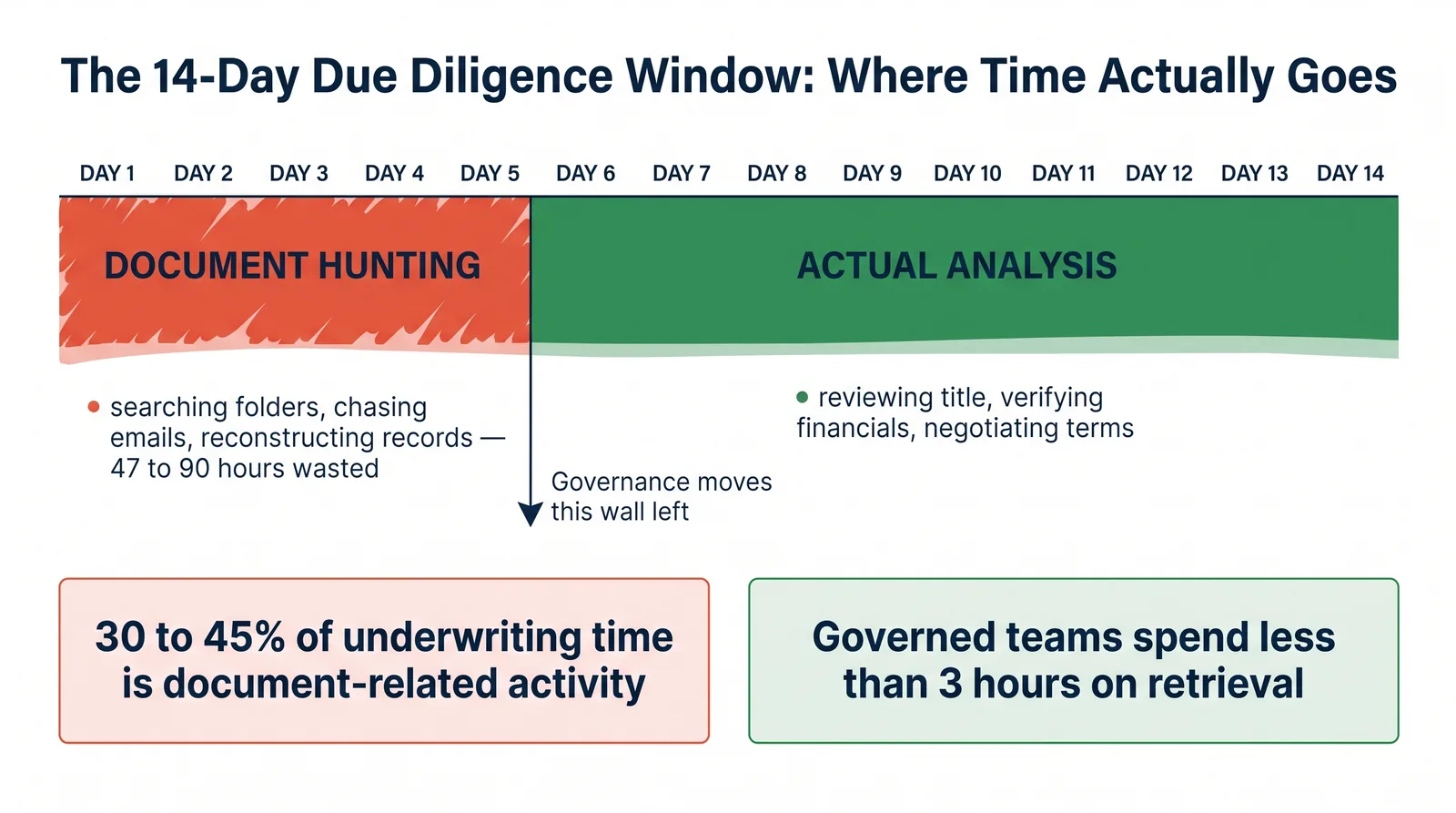
- Research from rets.ai indicates 30% to 45% of underwriting time goes to document tasks, not analysis.
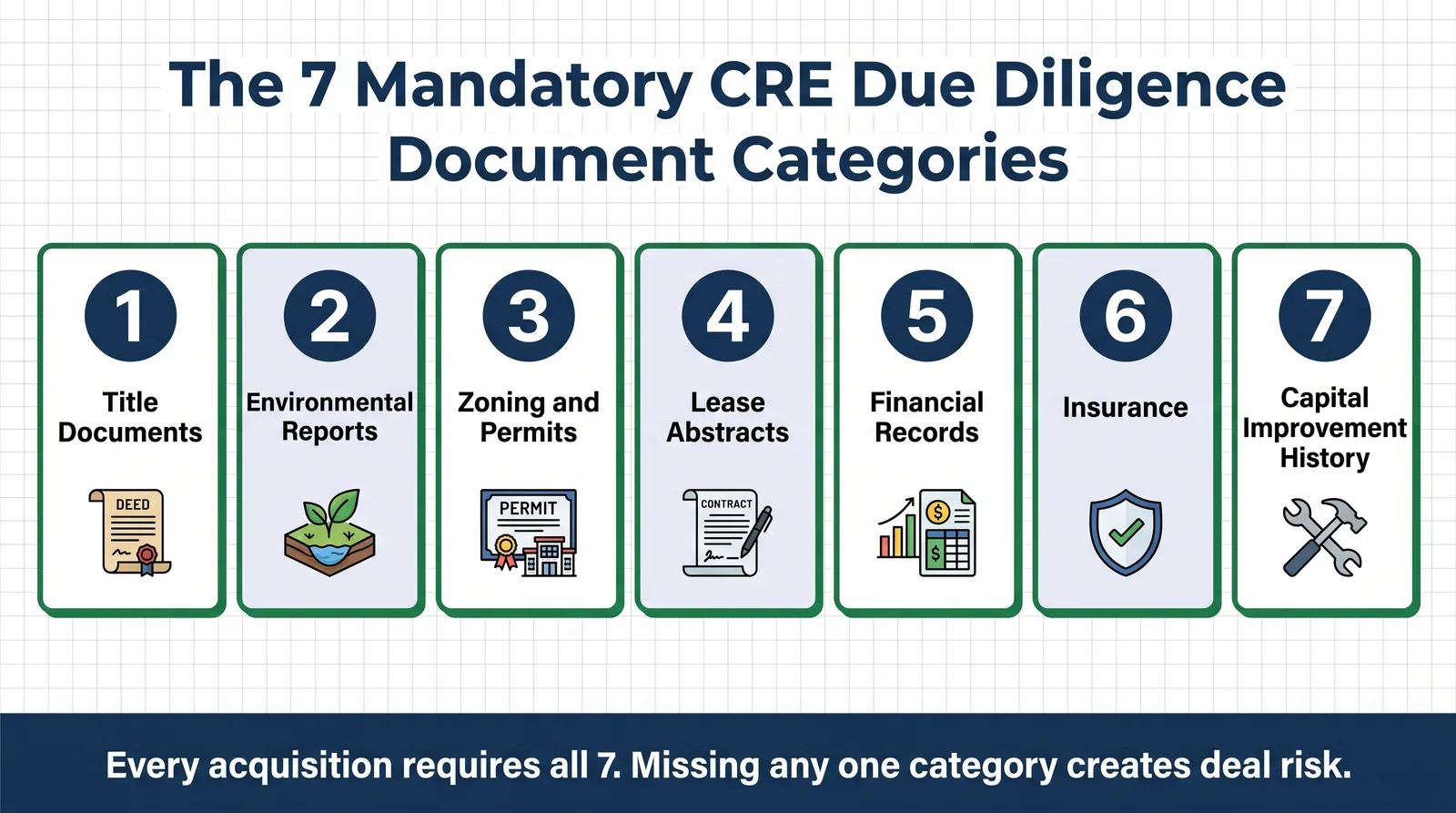
- Every CRE acquisition depends on seven mandatory document categories, and a gap in one can delay or kill a deal.
- Disorganization is not a filing issue. It is measurable deal risk under compressed timelines.
- A governed, centralized system built on existing tools solves retrieval before the 14-day clock starts.
The Deal That Almost Died in a Folder Structure
Westbrook Capital's Denver situation is common. Folder structures vary by market, naming is inconsistent, lease files are scattered across drives and email, and capital records often sit in stale spreadsheets.
The system feels acceptable in normal operations. Under deal pressure, it collapses. In Westbrook's case, document hunting consumed four days, nearly one-third of the 14-day diligence window.
The lesson is straightforward: speed during due diligence depends on readiness before diligence begins.
What the 14-Day Window Actually Demands
A 14-day CRE due diligence window is aggressive. Many deals still run 30 to 90 days, and complex transactions can run much longer. Competitive bidding and off-market pressure are making compressed windows more frequent.
Within 14 days, teams must execute all of the following in parallel:
- Collect and validate large document sets from sellers, counsel, and internal records
- Coordinate third-party title, environmental, and property condition inputs
- Run physical inspections and summarize findings
- Review lease packages and verify financial performance
- Confirm zoning, permits, and legal constraints
- Support legal negotiation on purchase agreement protections
Every task depends on documents. Time spent searching directly reduces time available for actual risk analysis.
The 7 Mandatory Document Categories for Every CRE Acquisition
1. Title Documents
- Current owner's title insurance policy or title commitment
- ALTA or NSPS land title survey
- Recorded deed and legal description
- CCRs, easements, and related declarations
- Lien search results and UCC filings
- Property-linked litigation history
2. Environmental Reports
- Phase I Environmental Site Assessment
- Phase II Environmental Site Assessment when needed
- No Further Remediation letters for prior cleanup
- Underground storage tank testing and closure records
- Mold assessments and remediation reports where applicable
3. Zoning and Permits
- Zoning compliance certificate for current use
- Variances and conditional use permits
- Certificate of Occupancy for all structures
- Open permits and unresolved code violations
- Special district fees and municipal notices
4. Lease Abstracts
- Executed copies of all active leases
- Rent roll with escalations and expirations
- Tenant estoppel certificates
- CAM reconciliations and lease changes
- Security deposits and TI obligations
5. Financial Records
- Three years of income and expense statements
- Rent collection history and delinquencies
- Property tax bills and assessment disputes
- Two to three years of utility bills
- Current operating budget and capital plan
6. Insurance
- Current property and casualty policies
- Three to five years of loss runs
- Open insurance claims
- Certificates of insurance from service providers
7. Capital Improvement History
- As-built drawings and architectural plans
- Executed construction contracts and change orders
- Major system warranties
- Maintenance and service agreements
- Permits for significant improvement projects
How Long Does It Really Take to Find These Documents?
In unorganized systems, retrieval time becomes the hidden deal killer. The range below reflects common operating patterns across CRE teams.
| Document Category | Avg. Documents Required | Retrieval Time (Unorganized) | Retrieval Time (Governed) | Primary Risk if Delayed |
|---|---|---|---|---|
| Title Documents | 6-10 | 6-10 hours | 20-40 minutes | Undisclosed liens survive closing |
| Environmental Reports | 3-6 | 8-14 hours | 15-30 minutes | Liability transfers to buyer |
| Zoning and Permits | 5-8 | 4-8 hours | 15-25 minutes | CO gap triggers lender hold |
| Lease Abstracts | 10-50+ | 12-24 hours | 30-60 minutes | Lease terms alter deal economics |
| Financial Records | 15-30 | 8-16 hours | 20-40 minutes | NOI gap delays underwriting |
| Insurance Documents | 4-8 | 3-6 hours | 10-20 minutes | Coverage gap pre-close |
| Capital Improvement History | 8-20 | 6-12 hours | 20-35 minutes | Unknown defects post-close |
| Total | 51-132 | 47-90 hours | 2.5-4 hours |
That is three to five working days lost to retrieval before review starts. Under a 14-day window, this is a direct competitive disadvantage.
Stop Searching. Start Closing.
ARC-Files gives enterprise CRE teams centralized search across their full SharePoint environment, every property, market, and document type, without migration.
Book a demo at arcfiles.com and see centralized search in action.
Why CRE Teams Keep Failing at Due Diligence Document Retrieval
Documents Live in the Wrong Places
Title files in one library, lease records in another, old reports in email, and capital history in orphaned spreadsheets create fragmentation that breaks under compression.
Naming Conventions Are Not Enforced
Inconsistent file naming removes confidence in search and forces manual open-and-verify workflows for each candidate file.
Version Control Does Not Exist
Multiple copies of changing reports accumulate across folders, and teams lose certainty on which version is current.
No Governance at Upload
Rules written in policy docs fail when intake is not controlled. Teams that perform consistently use systems that enforce structure at the point of upload.
Building a Due Diligence-Ready System Before the Clock Starts
Step 1: Set up taxonomy by property
Tag every document by property, category, and subtype using required metadata fields.
Step 2: Define version control rules
Ensure current versions are explicit and prior versions are preserved as superseded.
Step 3: Run quarterly readiness checks
Track completeness for all seven categories per property before deals surface.
Step 4: Centralize search portfolio-wide
Use one search layer across all markets and properties, not fragmented regional libraries.
Step 5: Enforce intake rules at upload
Required metadata, naming templates, and permission controls must be automatic at entry.
The Due Diligence Readiness Checklist
A No or Unknown answer in any row is a gap to close before the deal clock starts.
Title Documents
- Current title policy or commitment on file and reasonably current
- ALTA or NSPS survey reflects current boundaries
- Recorded deed and legal description in searchable governed storage
- Known easements, covenants, and restrictions documented
Environmental
- Phase I ESA available and current
- Phase II and remediation letters on file where applicable
- Underground storage tank records complete
Zoning and Permits
- Current zoning classification confirmed for intended use
- Certificates of Occupancy for all structures
- No unresolved code violations in file
Lease Abstracts
- All executed leases on file in current versions
- Rent roll current and reconciled
- Estoppel certificates current for active tenants
- CAM reconciliations complete for current and prior year
Financial Records
- Three years of income and expense statements on file
- Property tax bills for current and prior years accessible
- Outstanding balances and deferred rent agreements documented
Insurance
- Current property and casualty policies on file
- Loss runs for the past three years accessible
- Service contractor COIs current
Capital Improvement History
- As-built drawings reflect current layout
- Major system warranties documented
- Maintenance contracts and service agreements on file
Frequently Asked Questions
What documents are required for commercial real estate due diligence?
Most deals require seven categories: title, environmental, zoning and permits, lease abstracts, financial records, insurance, and capital improvement history. Standard deals usually require 200 to 500 documents.
How long does commercial real estate due diligence typically take?
Many deals run 30 to 90 days. Competitive scenarios can compress to 14 to 21 days, while complex transactions can extend much longer.
What happens if due diligence documents are missing or late?
Common outcomes are extension requests, repricing and risk reallocation, or termination. Lender timelines can also stall when required documents are incomplete.
What is the difference between a due diligence period and a closing period?
The diligence period is investigation and risk validation. The closing period handles funding and closing conditions. They may overlap depending on deal structure.
How should CRE teams organize due diligence documents?
Use metadata-driven governance over nested folders: tag by property, category, type, date, and version. This enables full-package retrieval in one search.
Can a CRE due diligence period be extended?
Yes, if allowed by contract and agreed by both parties. Extensions are often tied to additional earnest money or other commercial concessions.
The Bottom Line
A 14-day diligence window does not leave room for document chaos. The teams that close cleanly treat document readiness as an ongoing operating discipline.
That readiness does not require rebuilding your environment. It requires governance on top of the SharePoint foundation your team already uses.
See how ARC-Files gives enterprise CRE teams due diligence-ready search without file migration.
ARC-Files is a SharePoint-native document management platform for enterprise CRE teams, providing centralized search, compliance automation, and metadata governance across multi-market portfolios.
Keep reading
Suggested Articles
Continue exploring document management, SharePoint governance, and compliance for commercial real estate teams.