Records Management Software for Real Estate: Compliance, Retention, and Audit Readiness in 2026
Retention schedules, legal hold, disposition and audit trails for real estate records, plus a starter retention table with the reasoning behind each period.
Published August 22, 2026 · By ARC-Files · 19 min read
Published: August 22, 2026 | By ARC-Files
Records management software controls how business records are classified, retained, protected, placed on hold, reviewed, and eventually disposed of. In real estate, the challenge is that leases, title records, environmental reports, tax files, insurance evidence, and closing documents all have different lifecycle triggers and cannot safely share one blanket retention period.
A general counsel or compliance officer rarely has a storage problem. The harder problem is proving why a document still exists, why another was destroyed, whether a legal hold overrode normal disposition, and whether the record presented today is the same authoritative record the organization relied on years earlier.
Legal notice: This article provides records-management information, not legal advice. The starter schedule below must be reviewed and approved for your organization's jurisdictions, document classes, entities, tax positions, contractual obligations, and regulatory status before implementation.
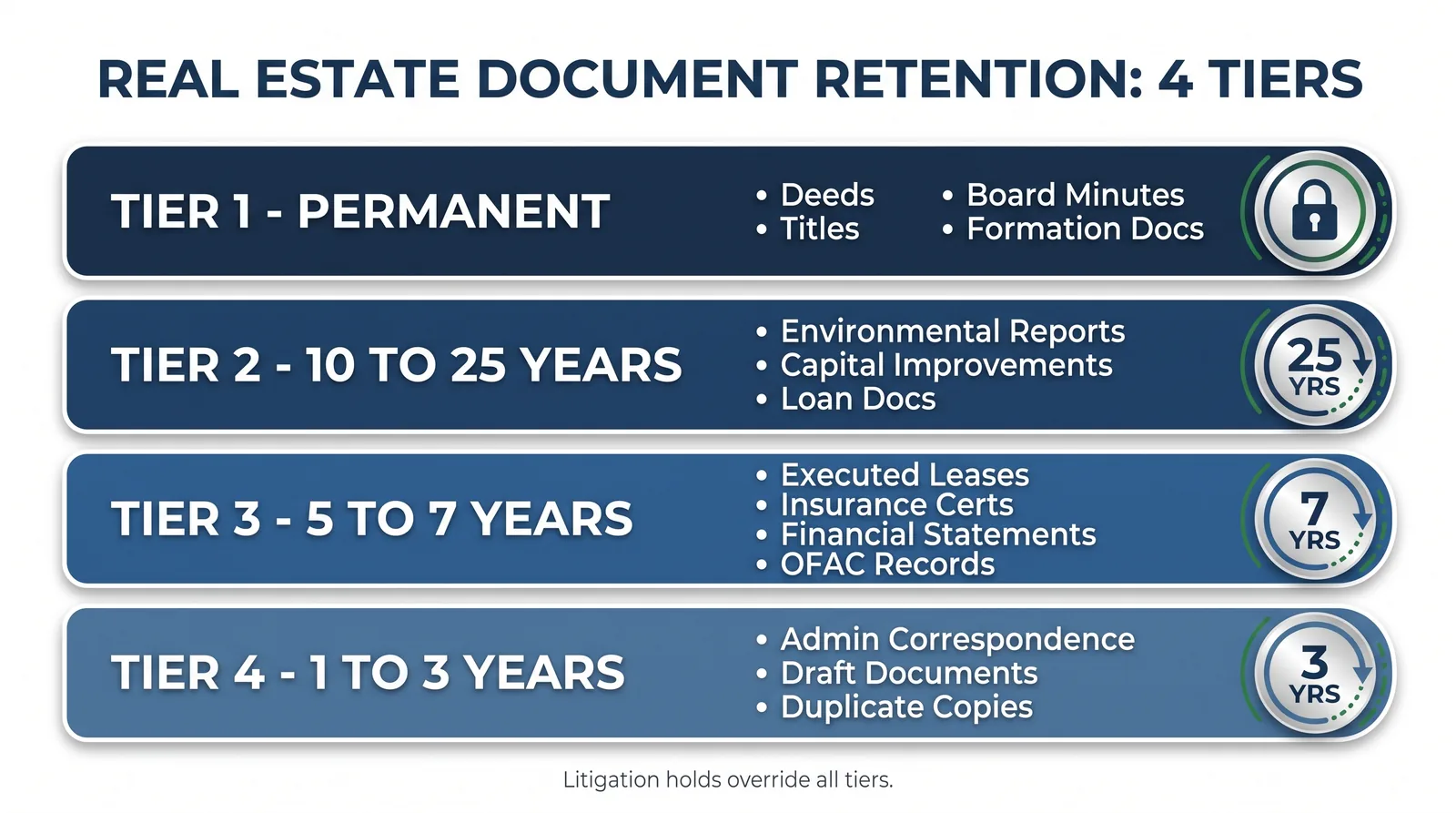
Key Takeaways
- Document management controls files; records management controls the obligations attached to those files over time.
- Real estate retention schedules work better when periods begin from business events such as lease termination, property disposition, claim closure, or contract completion rather than upload date.
- There is no defensible universal rule such as "keep every lease for seven years." Applicable statutes, tax rules, contractual obligations, litigation, and jurisdiction all matter.
- A trustworthy record must remain reliable, authentic, complete, and usable throughout its required lifecycle.
- Disposition is part of records management. Keeping everything forever is not a substitute for an approved retention policy.
Records Management vs. Document Management
A document management system helps an organization store, organize, search, version, share, and control documents. A records management system governs documents that have become evidence of a transaction, obligation, decision, right, or business activity, and manages those records through retention and final disposition.
The distinction matters because not every file requires identical treatment. A draft leasing proposal may be an ordinary working document. The final executed lease may be an official business record. A convenience copy of the executed lease in someone's local folder may be neither the authoritative record nor something that should receive its own independent retention schedule.
ISO 15489-1:2016 defines principles for creating, capturing, and managing records, including records metadata, responsibilities, controls, business requirements, and the processes used to manage records over time. The standard applies regardless of the technology or format in which the records exist.
ARMA's Generally Accepted Recordkeeping Principles similarly frame records as information that must be managed across a lifecycle from creation and use through retention and disposition, emphasizing accountability, availability, compliance, protection, transparency, trustworthiness, and lifecycle management.
That changes the question a real estate organization should ask. Instead of "where should we save the lease?" records management asks:
- Which copy is authoritative?
- What metadata establishes its context?
- When does its retention period begin?
- What event ends that period?
- Can a litigation hold suspend destruction?
- Who may authorize disposition?
- Can the organization prove what happened to it?
Related: Real Estate Document Management Software: The 2026 Enterprise Guide.
What Makes a Record Defensible: The Four Properties
NARA identifies four characteristics of trustworthy electronic records: reliability, authenticity, integrity, and usability. Those concepts provide a practical four-part test for real estate records.
1. Reliability
A reliable record accurately represents the transaction or activity it documents. For a lease file, that means users can determine which document was actually executed rather than relying on filenames such as Lease_FINAL.pdf, Lease_FINAL2.pdf, and Lease_Executed_NEW.pdf. A system can contain every version ever created and still fail the reliability test if nobody can determine which one governs.
2. Authenticity
An authentic record can be shown to be what it claims to be. That usually requires preserving context such as who created or received it, when it entered the system, which property and entity it relates to, its document type, its relationship to a parent agreement, its execution status, and its source. An executed lease without the metadata connecting it to the correct tenant and property is technically still a PDF, but it is a much weaker business record.
3. Integrity
Integrity means the record remains complete and protected against unauthorized alteration. NARA describes integrity as the record remaining complete and unaltered, and recommends documenting controls around additions, annotations, deletions, and modifications.
SEC Rule 17a-4 demonstrates how rigorous this requirement can become in regulated financial contexts. For broker-dealers subject to the rule, amended electronic-recordkeeping requirements permit either WORM storage or an audit-trail alternative capable of recreating the original record after modification or deletion. That rule does not automatically apply to every real estate company, but it illustrates the difference between merely retaining a file and retaining it in a defensible records system.
4. Usability
A record is not useful simply because it has survived. NARA defines usability in part around the ability to locate, retrieve, present, interpret, and connect a record to the business transaction that created it. A 20-year-old lease amendment may still exist inside an archive, but if the organization cannot connect the amendment to its original lease, property, tenant, and subsequent amendments, preservation alone has not produced a usable record.
Event-Based Retention: Why Real Estate Breaks Calendar-Based Schedules
A common retention configuration begins with a simple rule: keep the file for seven years after it was created. Real estate immediately exposes the weakness in that approach.
Consider two leases uploaded on the same date. Lease A has a three-year term. Lease B has a fifteen-year term plus renewal options. If both records are destroyed seven years after upload, one schedule is being applied to documents whose legal and business lifecycles are completely different.
The correct retention trigger is often an event. Examples include:
- lease expiration or termination;
- property disposition;
- contract completion;
- settlement of a claim;
- end of litigation;
- termination of a vendor relationship;
- final tax filing for a disposed asset;
- completion of a capital project.
Microsoft Purview explicitly supports event-based retention. A retention period can begin when an event occurs rather than from the age of the content itself, using contract expiration as one example of an event that starts the retention clock.
Executed Lease
→ active for the lease term
→ LEASE TERMINATED
→ retention clock begins
→ counsel-approved retention period
→ disposition review
→ destruction or extended retention
Why One Lease-Retention Number Does Not Work
Contract law alone demonstrates the problem. California generally uses a four-year limitations period for written-contract actions. New York CPLR §213 generally provides six years for contractual obligations or liabilities. Illinois 735 ILCS 5/13-206 provides a ten-year limitations period for actions on written leases and written contracts.
Those statutes do not automatically dictate a company's records schedule. Claims can accrue at different times, contractual provisions can matter, different causes of action can have different periods, and other regulatory or business requirements may require longer retention. They demonstrate why a national real estate portfolio cannot safely derive its retention schedule from an unsourced statement such as "leases must be kept for seven years."
A Starter Retention Schedule for Real Estate Document Types
Important: This table is a planning framework, not a legal retention schedule. Retention periods vary by jurisdiction, document purpose, entity type, tax treatment, contractual obligations, litigation status, regulatory regime, and company policy. Every production schedule should be approved by qualified counsel, tax professionals, compliance personnel, and records-management owners.
| Document type | Planning baseline to discuss with counsel | Trigger event | Governing consideration |
|---|---|---|---|
| Executed lease | Lease term plus applicable post-termination claims period; may range 4–10+ years | Lease expiration, termination, or final resolution of obligations | Written-contract limitation periods vary by jurisdiction (CA 4, NY 6, IL 10 years) |
| Lease amendment | Same schedule as the underlying lease | Termination of the agreement as amended | Amendment has little evidentiary meaning without the agreement it modifies |
| Estoppel certificate | Lease relationship plus counsel-approved transaction period | Transaction completion or lease termination | May evidence tenant representations relied on in financing or sale |
| SNDA | Duration of related lease and financing relationship plus claims period | Termination of relevant lease and financing relationship | Rights may depend on lease, lender, owner, and successor relationships |
| Title policy | Throughout ownership; post-disposition per legal and tax-basis needs | Property disposition and resolution of surviving title matters | Title evidence can remain relevant through disposition and later claims |
| Deed | Throughout ownership; usually preserve authoritative historical copy after disposition | Property disposition | Core evidence of ownership history; may support tax basis |
| Survey | Ownership period plus counsel-approved post-disposition period | Disposition or replacement by approved superseding survey | Boundary, easement, improvement, and dispute evidence |
| Phase I / Phase II ESA | Through ownership plus counsel-approved post-disposition period | Property disposition plus environmental-risk review | Do not treat the AAI freshness window as a destruction date |
| Certificate of insurance | Policy period plus applicable claim and contractual limitations period | Policy expiration and closure of known claims | Evidence of coverage may be needed after the certificate expires |
| W-9 | Commonly at least 3 years; longer where backup withholding applies | End of related reporting year or vendor relationship | Supports taxpayer-identification and information reporting; tax review required |
| CAM reconciliation | Lease relationship plus applicable contract and tax review period | Final reconciliation for the lease year and later lease termination | Supports tenant obligations, disputes, billing, and reporting |
| Rent roll | Through applicable tax and audit support period; longer if needed as evidence | End of reporting period, disposition, or final audit | Evidence supporting income, valuation, diligence, and reporting |
| CapEx invoice | With property-basis records through disposition plus tax limitations period | Taxable disposition of the asset | Capital expenditure records can affect basis and gain/loss calculations |
| Construction contract | Contract completion plus governing-law claims period | Substantial or final completion and final payment | Warranty, defect, lien, and construction claims may use different periods |
| Lien waiver | Project close plus applicable lien and claims period | Final payment and expiration of applicable lien exposure | Evidence supporting payment and lien-release history |
| Closing binder | Ownership period plus post-disposition tax and legal period | Property disposition | Consolidated evidence of acquisition, basis, title, financing, and approvals |
| Tax appeal file | Final resolution plus applicable tax limitations and appeal period | Final determination, payment, or refund | Supports assessments, appeals, adjustments, and tax positions |
| Tenant correspondence | Classify first; material correspondence follows the lease or claim schedule | Lease termination or closure of the related issue | Not every email is a record; notices, consents, and defaults may be |
Why the Table Uses Different Types of Periods
The IRS provides a particularly clear example of event-driven thinking. The IRS states that records relating to property should generally be retained until the period of limitations expires for the year in which the property is disposed of in a taxable disposition, because those documents can be necessary to establish tax basis and compute gain or loss.
That means a capital invoice from ten years ago might remain important because it affected the basis of a property that is still owned today. The age of the invoice is not the relevant trigger. The disposition of the property is.
For ordinary federal tax-supporting records, the IRS generally describes a three-year assessment period in standard cases, while also identifying circumstances involving longer periods or no limitation. For information returns, current IRS instructions generally require copies or reconstructable data for at least three years, extending to four where federal backup withholding was imposed.
Environmental due diligence provides another warning against confusing a document's use-by date with its retention date. EPA states that All Appropriate Inquiries generally must be conducted or updated within one year before acquisition, with specified components performed or updated within 180 days. That rule addresses whether due diligence is timely for an acquisition. It does not mean a Phase I ESA should be destroyed one year later.
Related: Document Retention Policy Real Estate: What to Keep, What to Delete, and for How Long.
Legal Hold: The Capability Most Teams Discover They Lack During Discovery
A retention schedule answers when a record may normally be destroyed. A legal hold answers what must stop that normal destruction process. Those are different controls.
Suppose a company's approved schedule permits destruction of certain lease-related correspondence six years after a defined event. Five years into that period, litigation becomes reasonably anticipated and legal identifies the documents as potentially relevant. Normal disposition must stop.
A mature records process needs to:
- identify the affected custodians, sites, libraries, mailboxes, or records;
- preserve relevant content;
- document the hold;
- prevent normal disposition from defeating preservation;
- maintain the hold until legal authorizes release;
- return the records to their normal lifecycle after release.
Microsoft Purview eDiscovery supports holds across sources including Exchange mailboxes, OneDrive accounts, SharePoint sites, and Microsoft 365 group or Teams locations. Content under a hold is preserved until the hold is released or removed.
The operational failure usually occurs before anyone opens the eDiscovery tool. A lease administrator may have a perfectly functioning seven-year deletion rule, while legal maintains a litigation spreadsheet separately. If nobody connects the legal matter to the records policy, automated disposal can continue doing exactly what it was configured to do.
legal matter → affected records identified
→ hold applied → hold verified
→ normal disposition suspended
→ matter resolved → counsel authorizes release
→ normal retention schedule resumes
A "do not delete" email to employees is weaker than a system-enforced preservation process, because the underlying content may exist across multiple repositories and custodians.
The Audit Trail: What an Auditor Actually Asks to See
An audit trail is useful when it answers a question. A thousand-page activity export is not automatically evidence of good governance. For a controlled record, an auditor, investigator, or internal reviewer may need to establish the following.
What is the authoritative record?
The organization should distinguish the official record from drafts, duplicates, exported data-room copies, and local convenience copies.
Who had authority to act on it?
Permissions should show who could create, modify, approve, classify, or dispose of the record.
What changed?
For controlled documents, the organization may need version history or audit information showing additions, changes, deletion attempts, or metadata changes.
When did the retention period start?
A defensible system should be able to explain why a record expires on a specific date. "Because the software calculated it" is incomplete. The chain should be explainable: retention class, trigger, termination event, counsel-approved period, and scheduled disposition date.
Was disposition suspended?
The audit trail should identify whether a legal hold, audit, investigation, tax issue, or other preservation requirement blocked deletion.
Who approved final disposition?
For higher-risk records, destruction should not depend on an employee manually emptying a folder. Microsoft Purview supports disposition review workflows in which designated reviewers can approve disposal, relabel records, extend retention, or add reviewers, and it records those actions.
SEC Rule 17a-4 offers a useful high-regulation benchmark: for affected broker-dealers using the audit-trail alternative, the system must preserve a time-stamped audit trail capable of recreating the original record after modification or deletion. FINRA Rule 4511 separately requires member firms to preserve books and records required under FINRA rules and applicable Exchange Act rules, applying a six-year default where no other period is specified. Those securities rules are not generic requirements for every property company; a real estate business should first determine whether it is actually subject to them.
Disposition: The Step Everyone Skips
Retention is not the same as permanent storage. A retention schedule should eventually answer what happens when the required period ends. Possible outcomes include destroy, review before destruction, transfer to an archive, extend retention, reclassify, or preserve permanently.
NARA's records lifecycle explicitly includes disposition as a lifecycle stage. ARMA likewise describes lifecycle management as extending through retention and disposition rather than ending once a record enters storage.
Keeping everything indefinitely can create its own risks.
- Discovery volume increases. If litigation arises, old material may need to be searched, collected, reviewed, and produced even if the business no longer has an operational reason to maintain it.
- Sensitive information accumulates. Old W-9s, tenant information, bank details, and contracts remain available to attackers and insiders for as long as they exist.
- Authoritative records become harder to identify. Five identical exports of a closing binder are not five times as useful; duplicates increase uncertainty over which copy governed.
- Systems become archives by accident. A property site designed for active operations gradually becomes a mixture of active records, expired records, convenience copies, and obsolete drafts.
Microsoft Purview's disposition functionality can require manual review before permanent deletion and supports actions such as extending retention or relabeling the item instead of destroying it. The purpose of disposition is not to delete more files. The purpose is to make destruction authorized, consistent, reviewable, and provable.
Implementing Retention in Microsoft 365: Labels, Policies, and Their Real Limits
Microsoft Purview Records Management currently supports file plans, retention labels, records declaration, automatic or manual label application, event-based retention, disposition review, proof of disposition, and records-management permissions. That is enough to implement sophisticated records controls inside a Microsoft 365 estate. But the technology does not write your retention schedule for you.
A Practical Implementation Model
- Build the records taxonomy. Define classes such as Executed Lease, Lease Amendment, Title Policy, Phase I ESA, Certificate of Insurance, and Closing Binder. Each class should have an owner and a business definition.
- Assign the governing retention rule. The rule needs a retention class, trigger, period, disposition action, legal authority or business rationale, and responsible approver.
- Capture the trigger data. If retention begins after lease termination, the system needs a reliable termination date. A perfect seven-year rule with an incorrect termination date remains incorrect.
- Apply the label. Retention labels can be manually published or automatically applied under supported conditions.
- Trigger business events. For event-based retention, Microsoft separates the retention label, event type, event, and asset identifier. The event starts the retention period for matching content.
- Review disposition. Higher-risk classes can route through one or more disposition-review stages before permanent deletion.
The Real Limits
Microsoft Purview solves the execution side of records management. It does not solve every governance decision.
- It does not decide what the law requires. Microsoft cannot determine whether a lease in Illinois should follow the same policy as a lease governed by California law. That is a legal and records-policy decision.
- It does not fix poor classification. If a lease amendment is tagged as "General Correspondence," the wrong retention rule can still be applied perfectly. Automation magnifies good and bad classification alike.
- Event-based retention requires reliable events. If one market enters the termination date in the PMS, another sends an email, and a third updates a spreadsheet, the retention system lacks a dependable source event.
- Legal hold remains a separate process. Normal retention and eDiscovery preservation interact, but the organization still needs a hold process that identifies affected content and verifies preservation.
- Records outside Microsoft 365 need their own answer. A portfolio may also keep documents inside Yardi, MRI, AppFolio, deal rooms, legal systems, local file shares, Box, Dropbox, or construction platforms. A Microsoft 365 retention policy cannot govern records that never enter its scope.
The implementation question is therefore not merely whether Purview can keep something for seven years. It is whether your organization can reliably classify the record, identify the correct trigger, preserve it when necessary, and authorize its disposal across every system where the authoritative record might live.
Where Records Management Software Is Overkill
Not every real estate organization needs a formal enterprise records-management system. A small owner with a handful of properties, limited document volume, one jurisdiction, straightforward tax records, and no unusual regulatory obligations may be able to maintain an effective counsel-approved schedule using its existing Microsoft 365 environment and disciplined procedures.
Additional software may be unnecessary when:
- record classes are few;
- retention triggers are simple;
- document volume is manageable;
- authoritative copies are clearly identified;
- legal hold is rare and already handled effectively;
- the existing system supports the required retention controls;
- one compliance owner can administer the policy without large-scale automation.
A records platform becomes more useful when complexity exceeds what manual governance can reliably control. Common signals include:
- several jurisdictions with different rules;
- hundreds of properties or entities;
- multiple document repositories;
- recurring audits;
- public-company requirements;
- litigation-heavy operations;
- acquisition-driven growth;
- inconsistent disposition practices;
- inability to prove why records were retained or destroyed.
Full enterprise ECM can also be more appropriate than a lightweight records layer when the organization needs complex case management, high-volume capture, sophisticated workflow adjudication, or records federation across many enterprise systems. The correct solution is the least complex system that can execute the approved policy reliably.
Frequently Asked Questions
How long do you have to keep lease documents?
There is no universal U.S. retention period for lease documents. A lease schedule should account for the term of the agreement, governing-law statutes of limitations, tax considerations, litigation, contractual requirements, and company policy. Written-contract limitation periods alone vary: California generally uses four years, New York six, and Illinois ten. A national portfolio should therefore use a counsel-approved schedule tied to lease termination or another defined event.
What is a retention schedule?
A retention schedule is a controlled policy that defines how long classes of records are retained and what happens when their required period ends. A useful schedule identifies the record class, retention trigger, period, governing rationale, owner, and final disposition action. Retention should reflect legal, regulatory, tax, contractual, historical, and operational requirements rather than arbitrary age.
What is the difference between records management and document management?
Document management focuses on storing, organizing, searching, sharing, versioning, and controlling documents. Records management adds lifecycle obligations such as formal record classification, retention, legal hold, disposition, audit evidence, and proof of destruction. A document-management platform can include records-management features, but storing a file does not by itself establish a records program.
Does Microsoft 365 have records management?
Yes. Microsoft Purview Records Management supports file plans, retention labels, record declaration, automatic labeling, event-based retention, disposition review, and proof of disposition across supported Microsoft 365 workloads. Microsoft 365 provides the technical controls, but the organization remains responsible for defining legally appropriate record classes, retention periods, triggers, and governance procedures.
What is event-based retention?
Event-based retention starts a record's retention period when a defined business event occurs rather than simply when the file was created. Microsoft Purview supports this model through event types, events, retention labels, and asset identifiers. Real estate examples include lease termination, contract completion, property disposition, or another event approved in the organization's records schedule.
Where ARC-Files Fits
ARC-Files, the SharePoint-native document management platform from Al-Rafay Global, is designed for real estate organizations that already keep documents in Microsoft 365 but need stronger consistency around search, metadata, retention, expiration monitoring, audit history, and governance across markets.
Its architecture deploys SPFx modules inside the customer's own Microsoft 365 tenant, with no required third-party document migration, and includes capabilities positioned around centralized document search, compliance controls, metadata governance, and multi-market management.
ARC-Files does not determine a company's legal retention obligations. Records schedules, legal holds, jurisdiction-specific periods, and regulatory interpretations remain the responsibility of the organization's counsel and compliance owners.
For organizations evaluating document and records controls inside SharePoint, review the ARC-Files feature set.
Sources Cited
- ISO 15489-1:2016 — concepts and principles for records creation, capture, metadata, controls, responsibilities, and management over time.
- ARMA International — Generally Accepted Recordkeeping Principles — lifecycle, accountability, availability, compliance, protection, transparency, and trustworthiness.
- National Archives and Records Administration — reliability, authenticity, integrity, and usability as characteristics of trustworthy electronic records.
- Microsoft Learn — Microsoft Purview Records Management — file plans, retention labels, event-based retention, record declaration, and disposition.
- Microsoft Learn — eDiscovery holds — preservation of relevant content in Microsoft 365 locations during legal or investigative matters.
- SEC Rule 17a-4 guidance — electronic-recordkeeping requirements and WORM or audit-trail alternatives for applicable broker-dealers.
- FINRA Rule 4511 — books-and-records preservation obligations for FINRA member firms, including the six-year default where applicable.
- Sarbanes-Oxley Act §802 / 18 U.S.C. §1520 — retention requirements concerning specified audit and review records of issuers.
- Internal Revenue Service Topic 305 and business recordkeeping guidance — property-basis records and general federal tax recordkeeping periods.
- U.S. EPA — All Appropriate Inquiries — timing requirements for environmental due diligence before property acquisition.
- Illinois 735 ILCS 5/13-206 — ten-year limitations period for specified written contracts and written leases.
- New York CPLR §213 — six-year limitations period for specified contractual obligations.
- California Code of Civil Procedure §337 guidance — four-year limitations period for written contracts.
Last updated: August 22, 2026
Keep reading
Suggested Articles
Continue exploring document management, SharePoint governance, and compliance for commercial real estate teams.