Document Retention Policy Real Estate: What to Keep, What to Delete, and for How Long
A practical retention policy guide for CRE teams covering federal and state timelines, retention tiers, Purview automation in SharePoint, and litigation-risk retention mistakes.
Published August 3, 2026 · By ARC-Files · 17 min read
Published: August 3, 2026 | By ARC-Files
Every commercial real estate firm needs a clear document retention policy. Too many teams rely on vague "seven-year" rules, historical habit, or the assumption that keeping everything is safest.
It is not. Over-retention expands discovery exposure. Under-retention can trigger audit failures, evidentiary gaps, and sanctions risk when a dispute emerges years later.
A working policy does three things: it defines exact retention windows by document type, enforces lawful disposition when windows expire, and produces a defensible log proving the policy was followed consistently.
This guide covers federal and state retention baselines, a practical retention schedule by document type, Purview-based automation in SharePoint, and the three mistakes that most often expose CRE firms to litigation.
Key Takeaways
- IRS limitation windows are commonly 3 to 7 years, but ownership and entity-defining records should usually be retained permanently.
- OFAC moved some transaction recordkeeping from 5 to 10 years effective March 2025, and many schedules still have not been updated.
- State and litigation exposure often push practical retention longer than federal minimums.
- Microsoft Purview labels, auto-applied using SharePoint metadata, are the most reliable way to enforce enterprise-scale retention policy.
- The highest-risk errors are deleting through active legal holds, forcing one period for all document types, and failing to log destruction.
Why Document Retention Is a Legal Duty, Not a Filing Task
Retention policy in CRE intersects tax law, securities obligations, state licensing rules, and litigation procedure. Courts do not treat this as filing hygiene. They treat it as legal governance.
Once litigation is reasonably anticipated, preservation obligations begin. Continuing routine deletion without hold checks can create spoliation exposure, even when deletions were otherwise "on schedule."
The opposite problem is over-retention. Keeping documents indefinitely broadens what can be compelled in discovery and raises review cost during disputes.
Strong policy balances those risks by defining what to keep, when to delete, and exactly how to document lawful destruction.
What Federal Law Requires CRE Firms to Keep
Federal requirements vary by regulator and document type, not by a single universal timeline.
- IRS: 3 years standard, 6 years for major underreporting, 7 years for bad debt or worthless securities claims, and indefinite in certain no-return or fraud scenarios.
- RESPA/TILA: many settlement and closing records require 5-year retention windows.
- OFAC: selected transaction records now require 10 years from March 2025.
- OSHA: exposure and medical records can require employment duration plus 30 years.
- SEC/REIT context: many disclosure-support records are retained 7 years or longer.
Why State Requirements Often Run Longer Than Federal Minimums
Federal law sets the floor. State law and contract-litigation windows frequently set the practical ceiling. CRE teams should retain to whichever standard is stricter.
A common pattern is statutory minimums around 3 to 5 years, while practical exposure for transaction disputes lands closer to 6 or 7 years for many categories.
Multi-market operators should maintain jurisdiction-aware schedules rather than relying on one generalized assumption.
How to Classify Real Estate Documents by Retention Tier
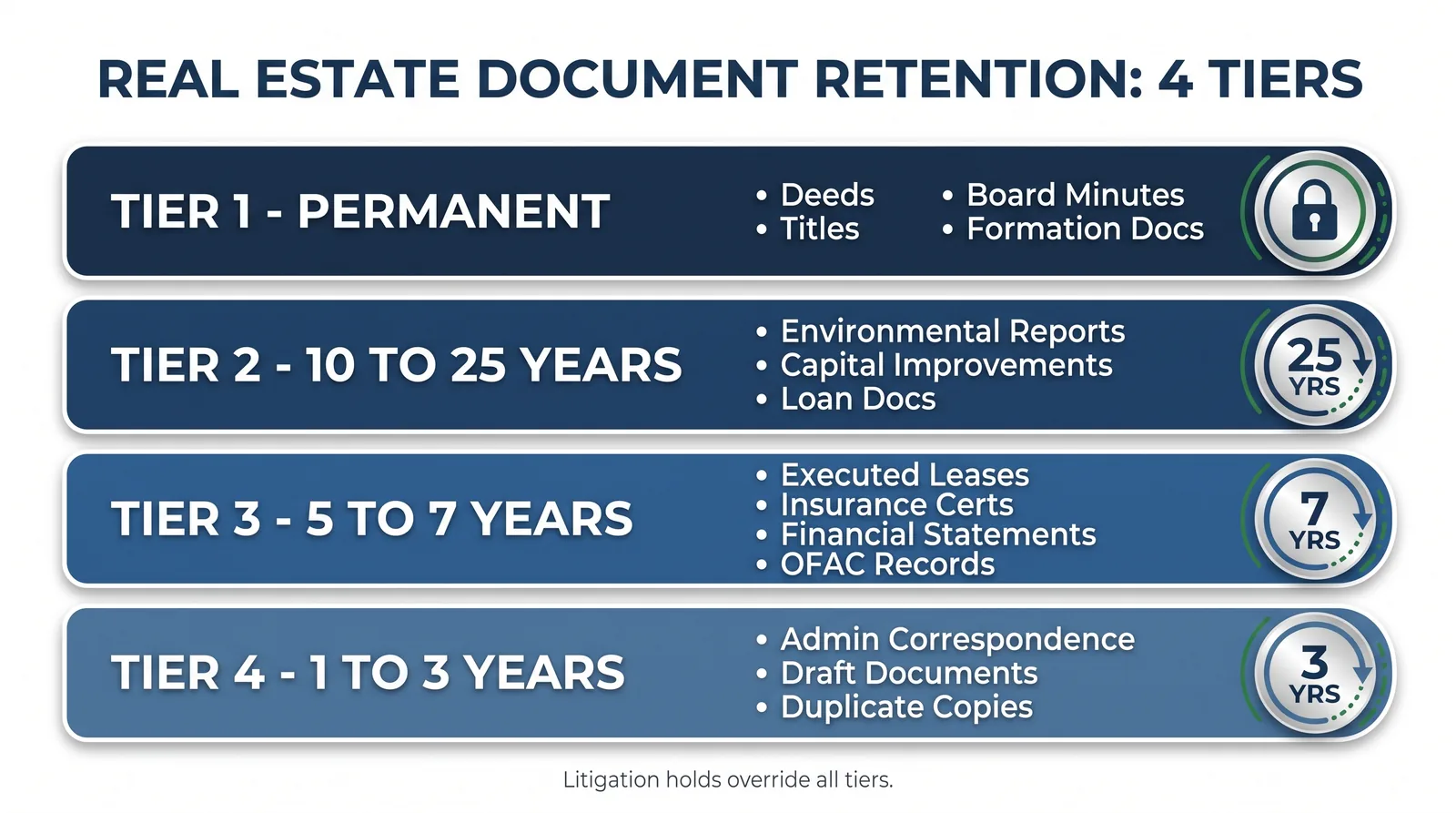
A practical retention model starts with four tiers before assigning exact periods.
- Tier 1 (Permanent): ownership-defining and entity-governance records.
- Tier 2 (Long-term): asset lifecycle, environmental, and long-tail risk records.
- Tier 3 (Standard business): contractual and financial operating records with defined windows.
- Tier 4 (Short-term admin): routine correspondence and superseded drafts.
Real Estate Document Retention Schedule by Document Type
Use counsel-reviewed schedules by category. The table below provides an operational baseline for enterprise CRE teams.
| Document Category | Recommended Retention | Tier |
|---|---|---|
| Deeds, titles, easements | Permanent | 1 |
| Environmental assessments | Asset life + 10 years | 2 |
| Executed leases and amendments | Lease term + 7 years | 3 |
| OFAC-related transaction records | 10 years | 3 |
| Superseded drafts and duplicates | 1 year | 4 |
Note: active or anticipated litigation holds override all scheduled destruction.
How to Automate Retention in SharePoint Using Microsoft Purview
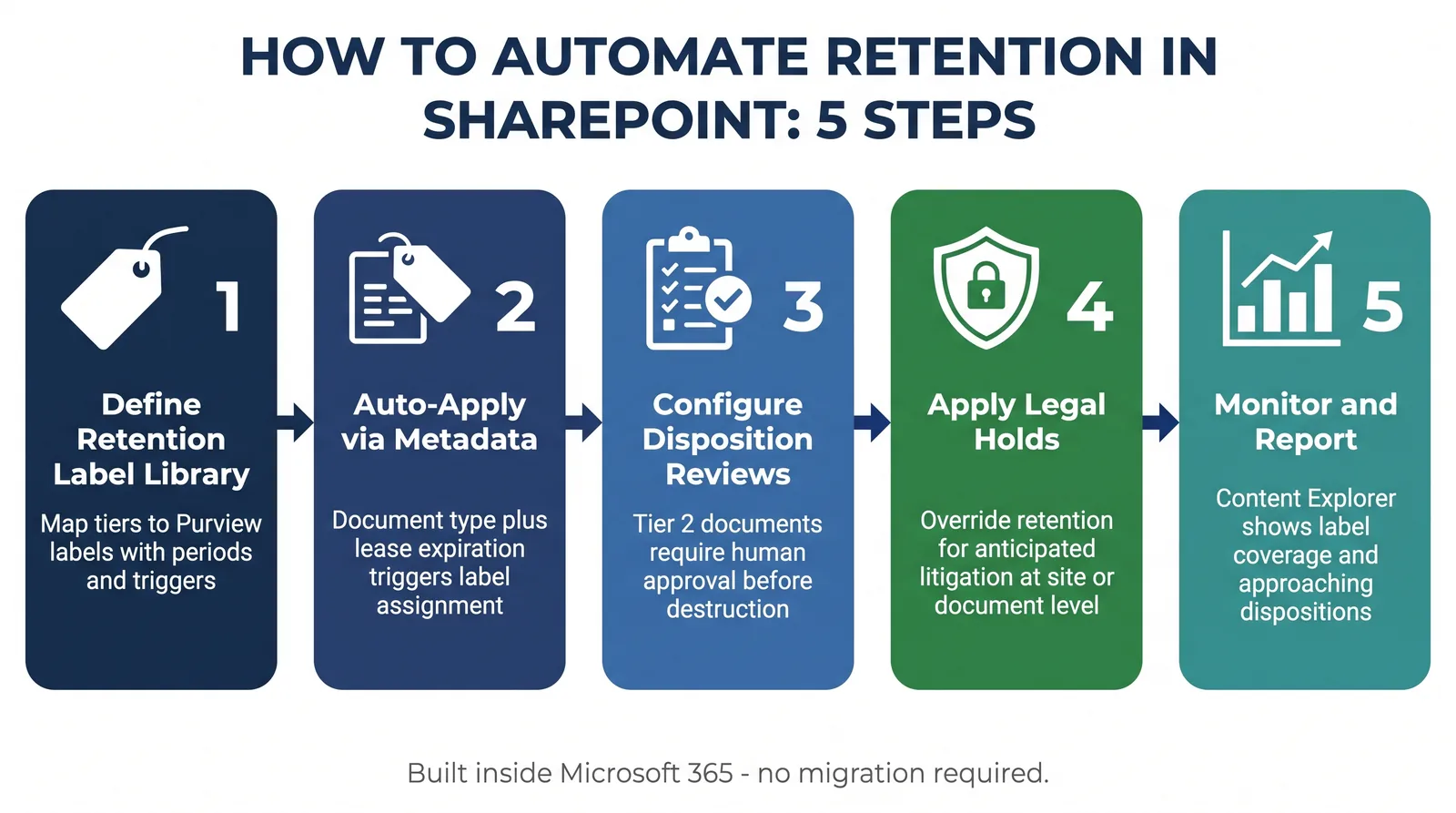
- Define retention labels aligned to your tiered schedule.
- Auto-apply labels using governed metadata values in SharePoint libraries.
- Use event-based triggers where retention starts on lease expiration or similar business events.
- Configure disposition review workflows for sensitive categories instead of blind auto-delete.
- Apply legal holds centrally and monitor policy application with Purview reporting.
ARC-Files configures this governance layer directly on top of existing SharePoint environments, including labels, auto-apply logic, disposition workflows, and hold procedures.
The 3 Retention Mistakes That Expose CRE Firms to Litigation
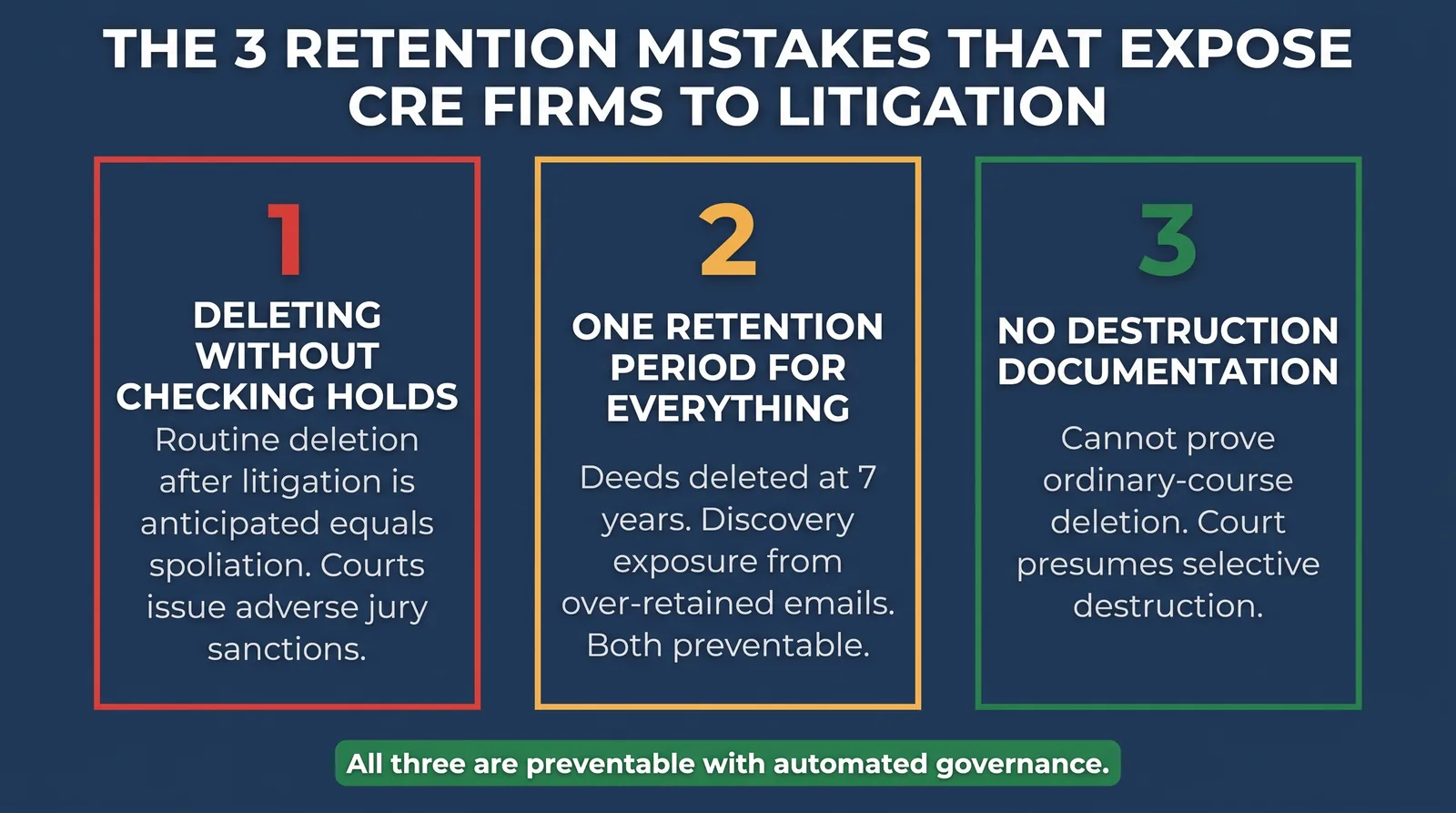
- Deleting without legal-hold checks. A valid schedule never overrides active preservation duty.
- Using one retention period for all documents. This creates both under-retention and over-retention at the same time.
- Failing to log destruction events. Without destruction evidence, routine deletion is hard to defend in disputes.
Building a Policy That Actually Gets Followed
Policy adoption is usually an enforcement problem, not a drafting problem. Teams need controls in-system, clear owners, full electronic-record coverage, and annual review cycles tied to legal change.
- Retention logic must live in the platform, not only in policy documents.
- Assign explicit responsibility for hold administration and disposition review.
- Cover SharePoint, email, Teams, and attachment pathways consistently.
- Revalidate schedules at least yearly and after material regulatory updates.
Frequently Asked Questions
How long should a CRE company keep executed lease documents?
A common baseline is lease term plus 7 years, with counsel adjustments for jurisdiction, deal type, and specific litigation posture.
Is there one federal law that defines real estate retention schedules?
No. Retention obligations are a stack of IRS, lending, sanctions, securities, labor, and state-level requirements applied by document type.
What should a commercial real estate retention schedule include?
It should include document category, retention period, trigger event, disposition method, hold override logic, and auditable destruction records.
How do SharePoint retention policies scale across a portfolio?
They scale when metadata is governed and Purview labels are auto-applied, with event-based triggers and centralized hold/disposition workflows.
Can documents be deleted before retention periods end?
No, not when legal, regulatory, contractual, or hold obligations still apply. Deletion should occur only after controls confirm eligibility.
The Practical Path Forward
Document retention for real estate is operating infrastructure, not a checkbox. The durable model is a tiered schedule, automated enforcement, legal-hold override, and destruction proof built directly into the Microsoft 365 stack.
ARC-Files implements this in SharePoint without migration, including metadata architecture, Purview label policies, event triggers, and compliance reporting workflows.
See how ARC-Files structures retention governance for enterprise CRE teams at arcfiles.com.
Keep reading
Suggested Articles
Continue exploring document management, SharePoint governance, and compliance for commercial real estate teams.