SharePoint Enterprise Keywords vs Managed Metadata Real Estate: Which Tagging Approach Does Your Portfolio Need?
A practical guide for CRE teams comparing enterprise keywords and managed metadata in SharePoint, including scale breakpoints, governance tradeoffs, and migration planning.
Published August 5, 2026 · By ARC-Files · 16 min read
Published: August 5, 2026 | By ARC-Files
The SharePoint enterprise keywords vs managed metadata real estate debate surfaces in almost every CRE portfolio scale-up. Teams enable the Enterprise Keywords column, encourage tagging, and discover months later that vocabulary variance has made search, reporting, and compliance slower than before.
This is rarely a training failure. It is a design failure. Flat, open tagging models become unstable as properties, markets, and contributors increase.
This guide explains how each model works, where keyword-based tagging breaks down, when managed metadata becomes mandatory, and how to migrate without re-uploading documents.
Key Takeaways
- Enterprise keywords are user-driven, flat, and difficult to govern at portfolio scale.
- Keyword columns can be filtered, but practical grouping and reporting remain limited for multi-market CRE operations.
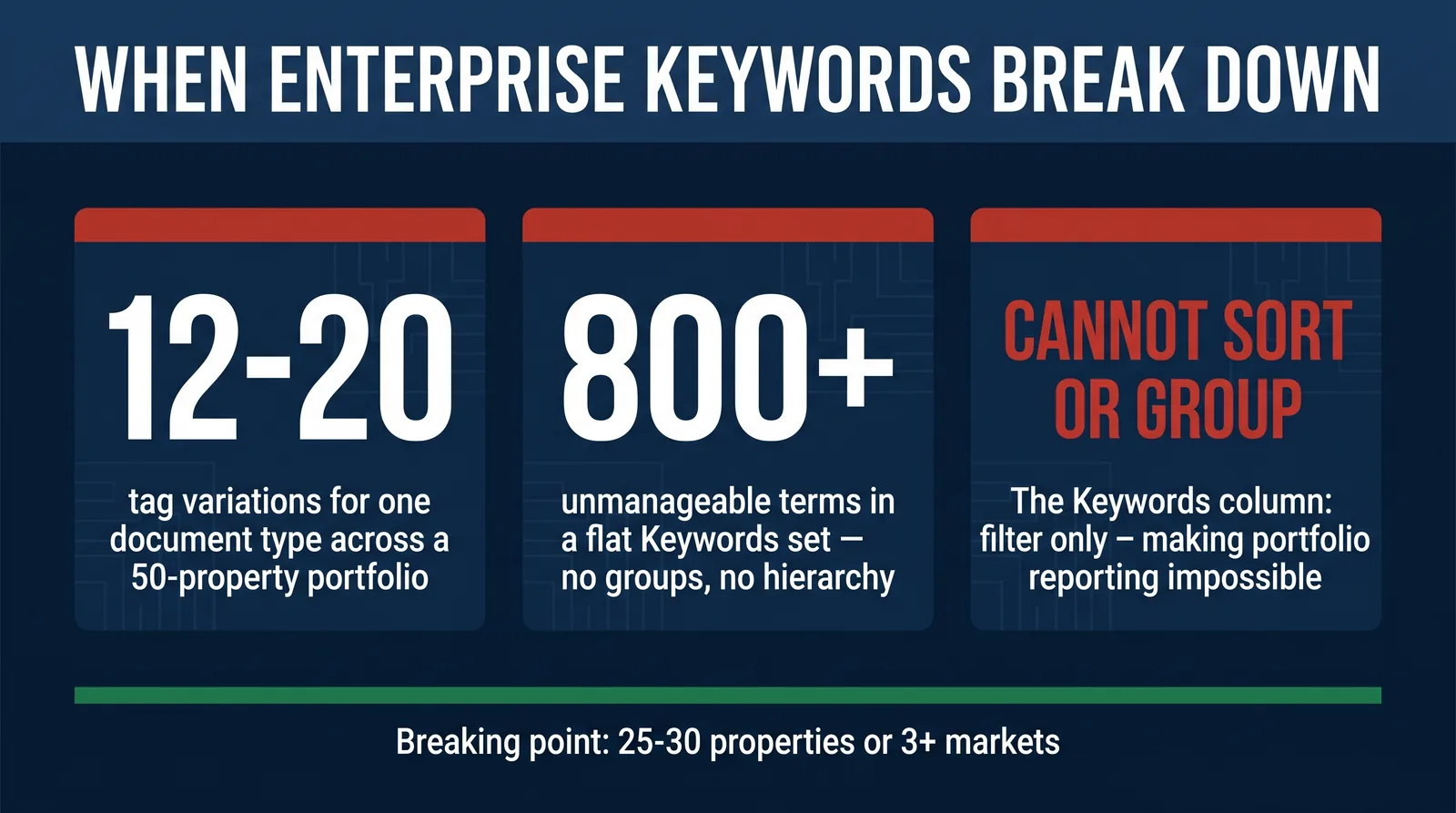
- Most portfolios hit a governance tipping point around 25 to 30 properties or 3+ markets.
- Managed metadata requires upfront taxonomy design but enables durable search, reporting, and auditability.
What Is Managed Metadata?
Managed metadata is controlled tagging built in the SharePoint Term Store. Administrators define term groups and term sets, and users select approved terms rather than creating uncontrolled variants.
- Term Group: portfolio-level container.
- Term Set: classification domain such as Market, Document Type, or Deal Stage.
- Term/Sub-term: standardized values supporting layered filtering and roll-up reporting.
Managed metadata also supports centralized term renaming, synonyms, and role-based maintenance, all of which improve long-term governance stability.
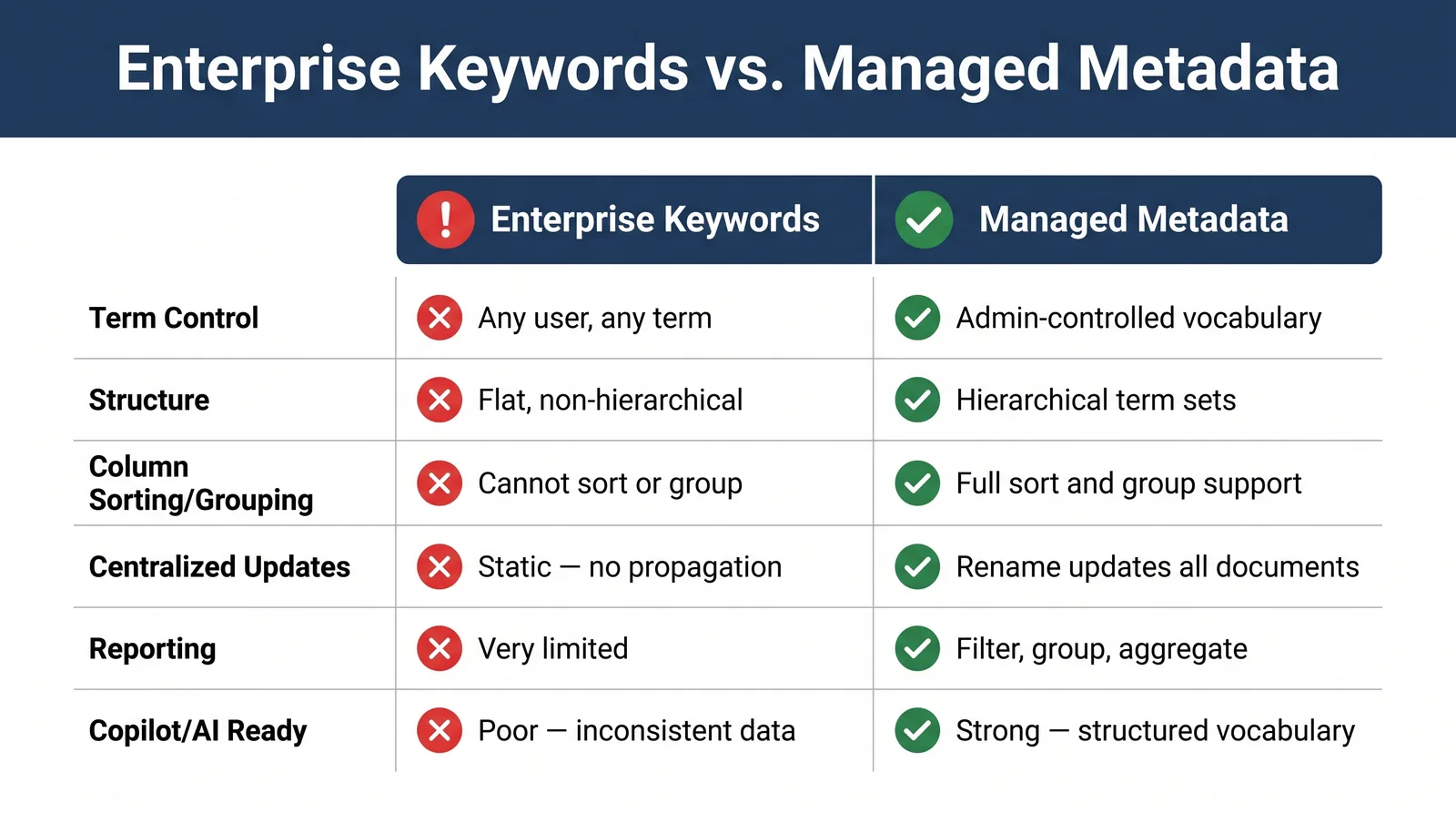
SharePoint Enterprise Keywords vs Managed Metadata
| Feature | Enterprise Keywords | Managed Metadata |
|---|---|---|
| Term control | Any user | Admin-managed |
| Structure | Flat | Hierarchical |
| Reporting readiness | Limited | Strong |
| Synonyms and roll-up | No | Yes |
| Best fit | Small portfolios | Scaling portfolios |
Why Enterprise Keywords Create Governance Chaos at Scale
Three failure patterns recur in large CRE portfolios: vocabulary sprawl, reporting dead ends, and search inconsistency caused by tag variance.
- Vocabulary sprawl: many near-duplicate terms for the same document type.
- Reporting dead end: practical grouping and repeatable reporting become brittle.
- Search cascade: semantically similar files fail to resolve under a single query.
When Does Managed Metadata Become Non-Negotiable?
- 25+ properties under management.
- 3+ active markets with distinct naming habits.
- Investor reporting or audit-readiness requirements.
- ASC 842 or IFRS 16 documentation traceability needs.
- Upcoming Microsoft Copilot rollout requiring cleaner metadata context.
Decision Framework: Which Should You Choose?
Enterprise keywords can work for smaller, low-variance environments. Managed metadata is generally the correct target model for portfolios expecting growth, cross-market complexity, and compliance-sensitive retrieval.
- Choose keywords for early-stage portfolios with limited scale.
- Choose managed metadata for established multi-market operations.
- Use a hybrid transition only with quarterly curation discipline.
Migrating from Enterprise Keywords to Managed Metadata
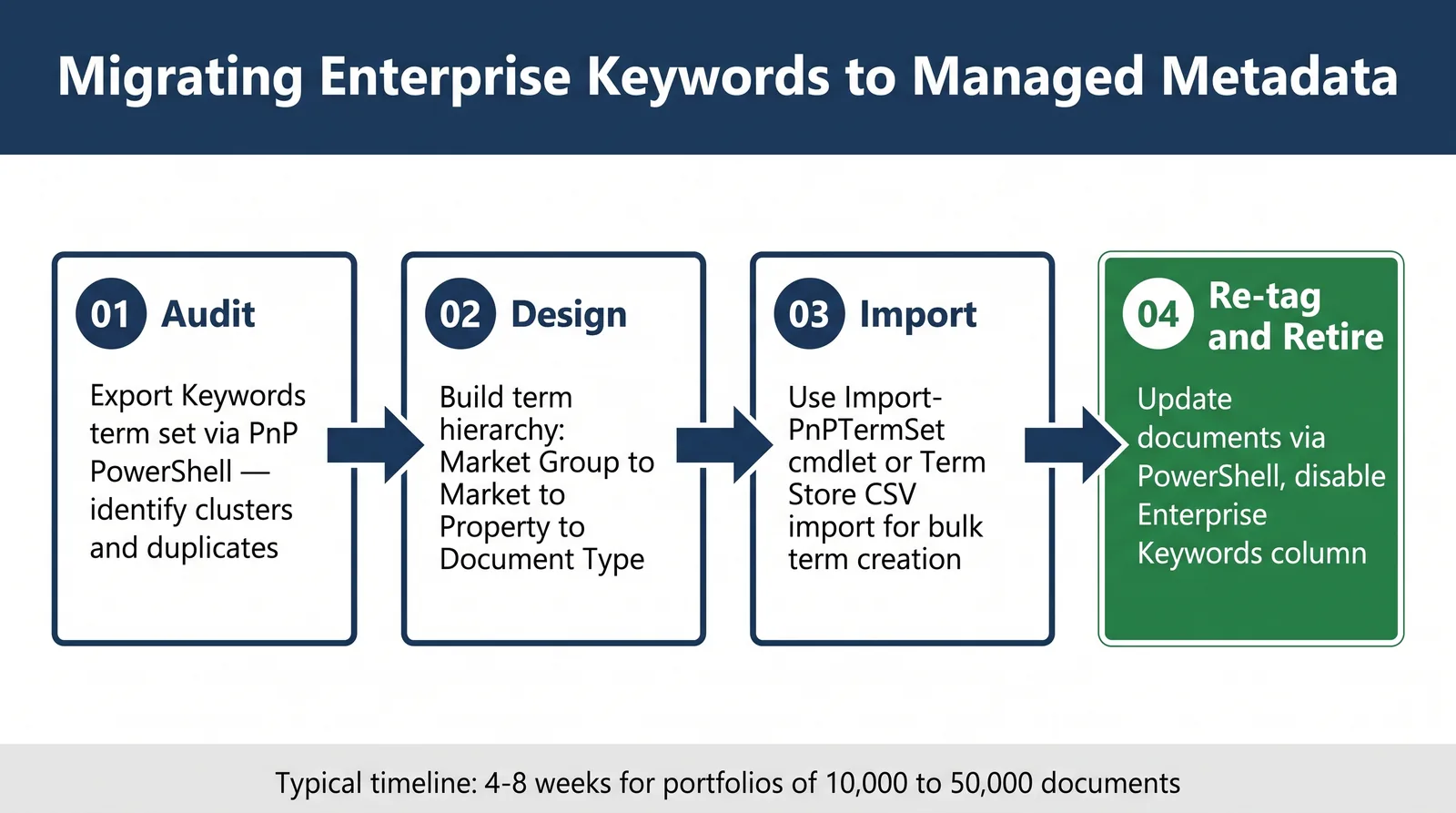
- Audit existing keyword values and cluster by classification domain.
- Design the target term hierarchy before production updates.
- Import terms and create managed metadata columns per domain.
- Bulk map existing tags to managed terms and retire keyword dependency.
The migration does not require document re-upload. For larger libraries, scripted mapping through PnP PowerShell is the standard execution path.
How ARC-Files Handles the Metadata Governance Layer
ARC-Files adds a SharePoint-native governance layer for enterprise real estate teams with structured term enforcement, upload controls, and cross-library reporting built for portfolio operations.
Frequently Asked Questions
Can enterprise keywords and managed metadata be used together?
Yes, but managed metadata should remain the primary governance system. If both run long-term, keyword curation is required to avoid drift.
Do existing enterprise keywords automatically move into managed metadata columns?
No. Existing values stay in place until you map and migrate them through manual or scripted remediation.
How long does migration usually take?
For many portfolios, planning and taxonomy design consume most effort, while scripted bulk mapping can execute quickly once rules are finalized.
Is managed metadata important for Copilot readiness?
Yes. Structured, consistent metadata improves context quality for AI-assisted retrieval and answer generation.
Can enterprise keywords be used in reporting?
They can, but reporting pipelines usually require additional normalization work compared with term-store-driven metadata structures.
Is managed metadata always worth it?
For very small, stable portfolios, enterprise keywords may be sufficient. For growth-oriented multi-market teams, managed metadata typically pays off.
The Bottom Line on SharePoint Tagging for Real Estate
Enterprise keywords are a useful starting point. Managed metadata is the long-term operating model for portfolios that need reliable search, reporting, and governance at scale.
Plan for the portfolio you intend to manage, not only the portfolio you manage today.
Keep reading
Suggested Articles
Continue exploring document management, SharePoint governance, and compliance for commercial real estate teams.